
Nutrient Measurements
The NCDA&CS compost report provides nutrient concentrations under the heading Nutrient Measurements. These values indicate the fertilizer value of the material.
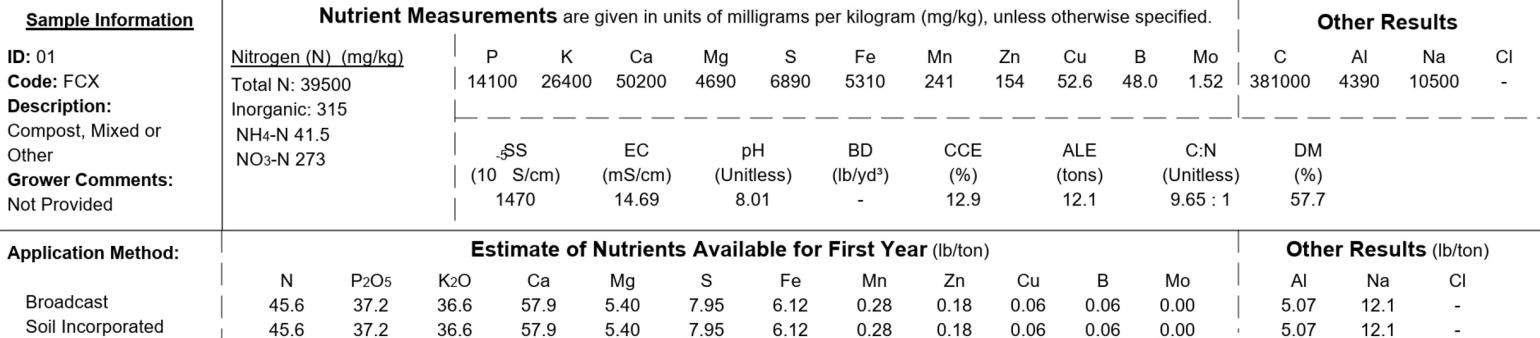
Nitrogen (N)
This is the total concentration of organic and inorganic nitrogen in mg/kg. Nitrogen is reported on an as-received (wet-weight) basis for composted animal manure, mortality compost, vermicompost, and biosolids. Plant-based compost (FCW) and compost that is a mixture of plant compost and other materials (e.g. ash, sand, manure, mulch) are reported on a dry-weight basis.
Inorganic nitrate-nitrogen (NO3-N) and ammonia-nitrogen (NH4-N) are not part of the standard analysis but can be added by request. This test is not generally needed for most compost, but may be useful for composted manure.
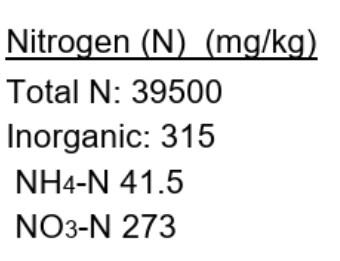
Other Nutrients
Concentrations of phosphorus (P), potassium (K), calcium (Ca), magnesium (Mg), sulfur (S), iron (Fe), manganese (Mn), zinc (Zn), copper (Cu), and boron (B) are reported in mg/kg on a dry-weight basis. Molybdenum (Mo) can be added by request during submission but is generally not needed for compost.

What is the "fertilizer grade"?
The fertilizer grade is the percentage of each nutrient in the material. Commercial fertilizers and compost materials list the grade of nitrogen (N), phosphorus (P) and potassium (K) on the label in the format of N%-P%-K%. For example, a compost label of 1 - 0.5 - 2 contains 1% nitrogen, 0.5 % phosphorus, and 2% potassium. To find the nutrient percentages on your report, simply move the decimal point 4 places to the left for each nutrient management. See examples in the table below.
| Nutrient | Nutrient Measurement from Report | Percentage |
|---|---|---|
| Nitrogen (N) | 39500 | 3.95 |
| Phosphorus (P) | 14100 | 1.41 |
| Potassium (K) | 26400 | 2.64 |
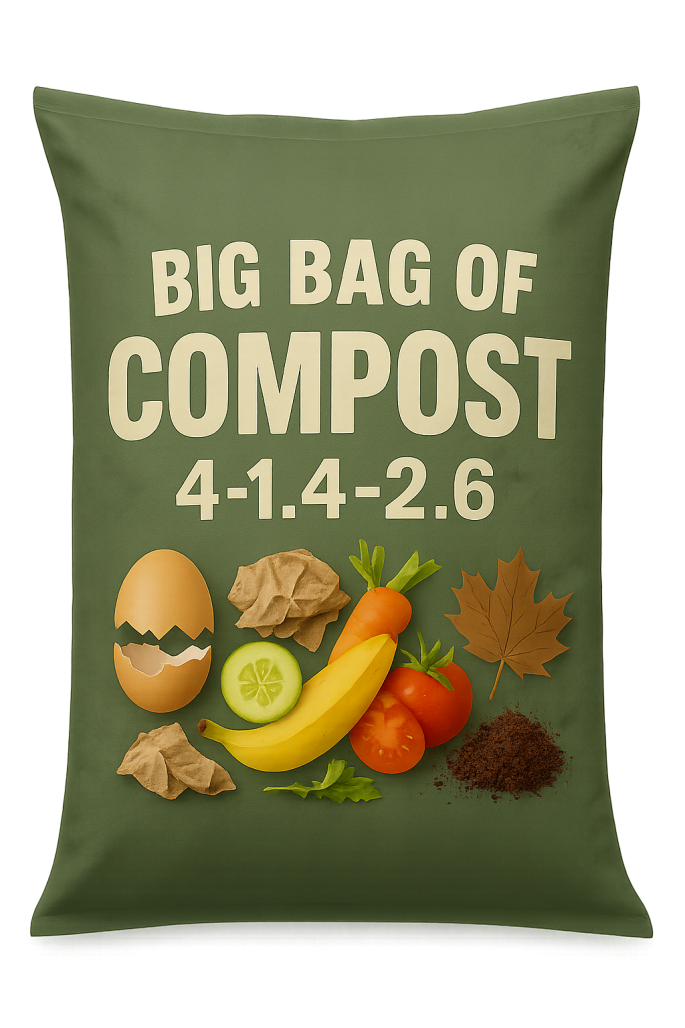
This material is about 4% N, 1.4% P, and 2.6% K and would have a NPK fertilizer grade of 4 - 1.4 - 2.6.
Important note: The Agronomic Division does not grade fertilizer or waste products for commercial sale. If you need guidance on how to sell compost in N.C., please contact the NCDA&CS Seed & Fertilizer Section.
What's a normal fertilizer grade for my compost?
Typical nutrient ranges for different compost types
Before you go, make sure you know how to convert from mg/kg on your report to %.
Estimate of Available Nutrients
In this section of the report, concentrations are reported on an as-received (wet weight) basis for all elements in lb/ton. The actual "estimate of availability" applies only to nitrogen and only to composted manure samples, For all nutrients other than nitrogen (e.g. P, K, etc.), the reported concentrations are the total concentrations in the sample.
Composted Livestock and Poultry Manure
For composted animal manure and animal mortality compost, the nitrogen availability estimate depends on the manure type (waste code) and application method (BR or SI) that you specified on the submission form and accounts for the fact that only 40-60% of the manure nitrogen becomes available in the first year. The nitrogen availability calculation for specific manure types was established by the North Carolina Interagency Nutrient Management Committee. The specific availability calculated for each waste code and application method is listed in Table 3 of the NCDA&CS Waste and Compost Analysis Guide.
Other Compost
For all other types of compost, including vermicompost (worm castings), composted biosolids, and mixed manure and non-manure materials, the reported nitrogen concentrations are the total concentrations in the sample. Due to the heterogeneity of these types of samples and other factors, actual nitrogen availabilities have not been established. Actual availability of nitrogen and other nutrients will be lower and will become available slowly as the material decomposes.
Application Method
When the sample was submitted, you should have listed the application method for the compost. If the intention is to surface apply the compost without incorporation (tilling or digging it in), the application method is Broadcast (BR). If the intention is incorporate the compost into the soil, the application method is Soil Incorporated (SI). If you did not specify the application method when the sample was submitted, both application methods were applied to your report. On the compost report, the application method affects the nitrogen availability value for composted manure but does not change the value reported for all other compost types. For non-manure compost, it should be noted that the application method does affect nutrient availability in practice. When compost is incorporated into the soil, nutrients become available to plants faster than when the compost is layered on the surface only.

Carbon (C) to Nitrogen (N) Ratio (C:N)
The carbon to nitrogen ratio (C:N) is a critical indicator of both the quality and stability of the compost. Carbon provides energy (food) to composting microbes, while N is crucial for their cell growth and function. An imbalance of C and N can lead to inefficient composting. An ideal starting C:N is 25:1 - 30:1. Ratios higher than this will slow the composting process and limit the release of plant-available nutrients, while lower ratios can lead to off-gassing of ammonia, odors, and overly wet, anaerobic compost.
As compost matures, the C:N ratio will drop. A C:N ratio in a finished compost should be 10:1 - 15:1. This indicates that it has "stabilized" and microorganisms will not excessively deplete plant available nutrients.
Testing individual feedstocks can help optimize mixing ratios. Common feedstock ratios are below.
| Materials High in C | C:N |
|---|---|
| Dried Leaves | 30-80:1 |
| Straw | 40-100:1 |
| Wood Chips and Sawdust | 100-500:1 |
| Bark | 100-130:1 |
| Paper | 150-200:1 |
| Newspaper and Cardboard | 560:1 |
| Materials High in N | C:N |
|---|---|
| Vegetable Scraps | 15-20:1 |
| Coffee Grounds | 20:1 |
| Grass Clippings | 15-25:1 |
| Manure | 5-25:1 |
From Dickson, N., T. Richard, and R. Kozlowski. 1991. Composting to Reduce the Waste Stream: A Guide to Small Scale Food and Yard Waste Composting
pH
Optimal pH for compost is between 6.0 and 7.5. Compost pH below 5.5 indicates that the material may be poorly aerated. When oxygen is limited, microbial decomposition switches from aerobic (with oxygen) to anaerobic (without oxygen). The latter process produces compost that is excessively acidic. Typically all that is needed is to remedy low pH is mixing and aeration.
Compost pH above 8.0 may limit the plant-availability of micronutrients (e.g. iron, manganese, and zinc).
What's a normal pH, EC, C:N or other parameter for my compost?
Other Parameters
EC (Electrical Conductivity) is reported in units of mS/cm. It measures the total quantity of dissolved salts (ions) in solution. It is often used as a general evaluation of the total nutrient concentrations available to plants. However, it also includes elements such as sodium (Na) and chloride (Cl), which increase EC without providing nutritional value. In addition, excessively high EC will burn plant roots regardless of the whether the ions are required for plant nutrition.
SS (Soluble Salts) is the same as EC, but is expressed in units of 10-5 S/cm.
CCE% (Calcium Carbonate Equivalent) represents the acid-neutralizing capacity of a material expressed as percentage of calcium carbonate. For compost materials with liming potential (e.g., lime-stabilized biosolids, ash, poultry layer litter), the application rate may be limited by a high CCE%. Compost with a high CCE% should only be applied at rates needed to increase soil pH to the desired target. Overapplication can lead to high soil pH, which may limit micronutrient availability.
ALE (Agricultural Lime Equivalent) calculates the amount of the compost that provides a liming effect equivalent to one ton of agricultural grade limestone. For example, an ALE of 2 indicates that 2 tons of the compost would have the same effect on soil pH as one ton of agricultural limestone.
CCE% is an optional test and is not automatically performed on compost samples.
DM% (Dry Matter) is the percent of the as-received sample that is dry solids and is inversely related to percent moisture. It is used in semi-solid and solid samples to convert the dry-weight nutrient measurement concentrations (mg/kg) back to wet-weight concentrations of the original sample, which are reported in the estimate of nutrients available for first year (lb/ton).
Heavy metal testing is optional and can be included at submission with an additional charge. The EPA has set maximum limits for compost.
| Heavy Metal | Maximum Concentration in Compost |
|---|---|
| Arsenic (As) | 41 mg/kg |
| Cadmium (Cd) | 39 mg/kg |
| Chromium (Cr) | N/A |
| Nickel (Ni) | 420 mg/kg |
| Lead (Pb) | 300 mg/kg |
| Selenium (Se) | 100 mg/kg |
Sodium (Na) and aluminum may damage plant roots at excessive levels. Aluminum may impact plant health when soil or substrate pH is excessively low.