
Sample Submission Options:
- Submit samples online (Preferred). Once you have completed the information online, print the entire submission form and include it with your samples.
- Submit samples manually:
- Predictive, routine samples. Complete the Soil Sample Submission Form for Homeowners, print it, and include it with your samples.
- Diagnostic samples. Complete the Soil Sample Submission Form-Diagnostic, print it, and include it with your samples. Diagnostic testing is for problem samples only. Samples submitted without diagnostic information will be analyzed as predictive.
Complete Sample Submission Form
- Samples will not be processed without the printed, submission form and all required fields completed.
- Client information must correspond to the property owner.
- Advisor information includes consultants, extension agents, etc. If you don't have an advisor, leave this section blank.
- Specify the crop code (lawn, vegetable garden, flowers etc.) associated with each sample. Recommendations are not provided without the crop code.
Package Samples
- DO NOT ship samples in paper envelopes or plastic bags.
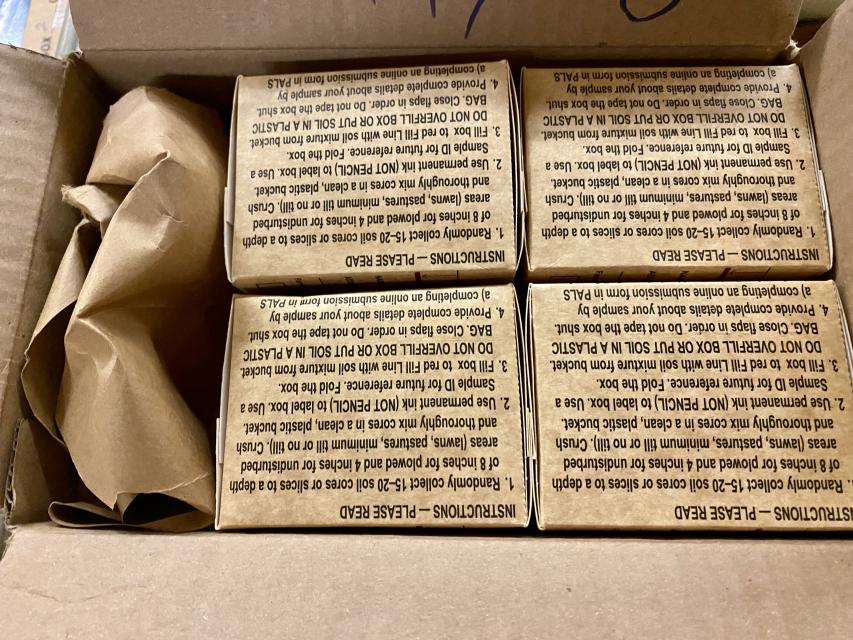
- Package boxes tightly in a cardboard to prevent damage during shipping.
- Do not tape the sample boxes.
- Make sure your completed submission form is included with your samples.
Frequently Asked Questions
Predictive
This is the most common type of soil sampling. Predictive testing is used to determine what nutrients are needed before planting or to maintain adequate fertility of established plantings.
Diagnostic
Diagnostic testing is used for "diagnosing" a soil fertility problem when a problem is occurring. Examples of this may be stunted growth, patches in the lawn, or discolored plants. To submit a diagnostic sample, collect samples from both the problem location and from a healthy location for comparison. Collecting and submitting corresponding plant tissue samples is helpful as well.
Sample IDs are a combination of up to 5 letters or numbers created by the person submitting samples and should be listed on both the soil box and the submission form. The sample IDs should reflect where the sample was collected (e.g. Lawn, Berry, Front) and allows the client to correlate the report data to these areas.Sample IDs are critical to understanding your soil report.
Crop codes indicate what the person is growing or intends to grow in that area. This information is vital to obtain lime and fertilization recommendations.
Homeowner crop codes are:
| Crop | Code |
|---|---|
| Azalea / Camelia | 020 |
| Lawn, Centipede | 022 |
| Lawn (not centipede) | 026 |
| Flower Garden | 023 |
| Vegetable Garden | 024 |
| Rose | 028 |
| Mountain Laurel / Rhododendron | 025 |
| Shrubs | 029 |
| Berries / Fruits / Nuts (except blueberries) | 030 |
| Blueberries | 032 |
| Landscape Tree (deciduous and evergreen) | 031 |
The Farm ID appears on the client report an on the PALS report page. It is useful in tracking samples from multiple locations.
Example: Someone has a home in Charlotte and also a beach house. They could use farm ID's "home" for the main home and "beach" for the other.
This is your account # that allows you to access your reports electronically on the customer Portal for Agronomic Laboratory Services. You can also update your information and pay for samples in your PALS account. Your PALS # is listed in the top right corner of the PALS homepage once you log in.
Shipping & Delivery
By Mail:
- UPS or FedEx: 4300 Reedy Creek Rd, Raleigh, NC 27607
- US Postal Service: 1040 Mail Service Center, Raleigh, NC 27699. Allow additional time for delivery.
By Courier: Many NCSU County Extension offices offer a courier service to deliver laboratory samples to the Agronomic Division. Contact your County Extension office to inquire if this service is available in your area.
In person: Soil samples may be dropped off at the Agronomic Division loading dock Monday-Friday between the hours of 7: 00 a.m. - 4:00 p.m., except N.C. State holidays.
This page was last modified on 11/13/2026