
Plant Industry - Yellow-Legged Hornet
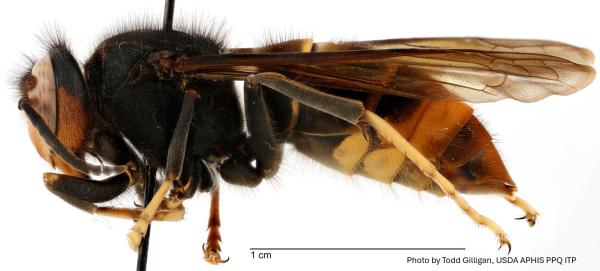
Pest: Yellow-legged hornet, Vespa velutina, is an invasive hornet native to southeast Asia that was first detected in the United States in Savannah, Georgia, in 2023. Since then, yellow-legged hornet has been detected in Chatham, Bryan, Effingham, and Liberty Counties in Georgia and Beaufort, Colleton, Charleston, Dorchester, Jasper, and York Counties in South Carolina. As of August 2026, the yellow-legged hornet has been detected in Union and Guilford counties in North Carolina.
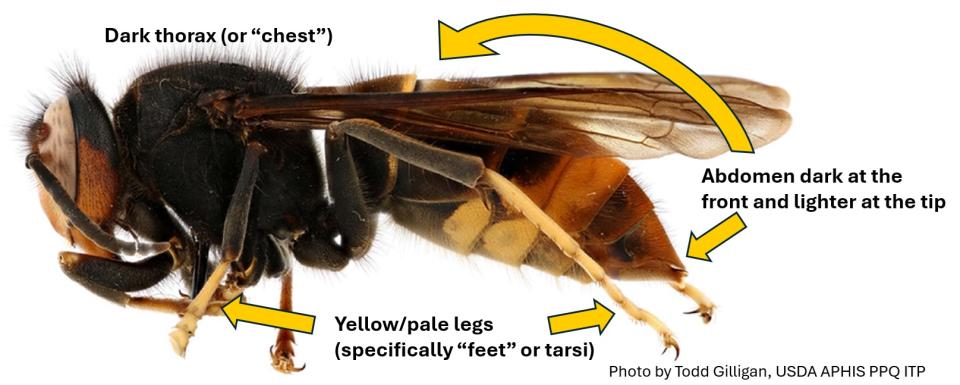
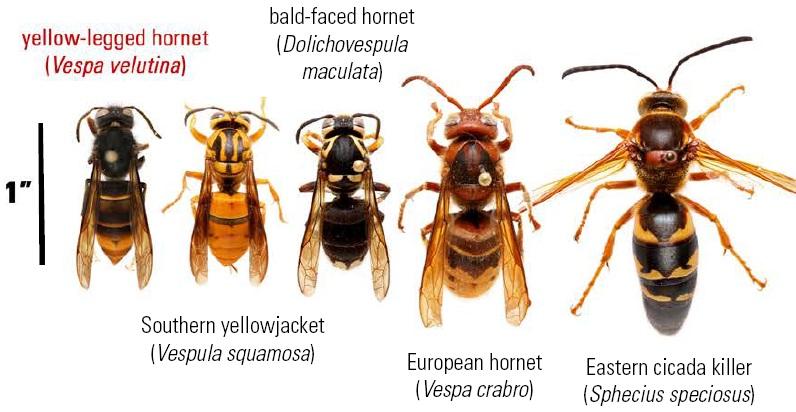
Identification: Adult yellow-legged hornets are about an inch long. The most distinctive feature is that the bottom half (the ‘feet’ or tarsi) of all its legs are yellow. It has a dark thorax (or ‘chest’), with the abdomen dark at the base growing lighter or paler towards the tip.
Problem: This hornet is a predator of honey bees, as well as native bees and insects. Yellow-legged hornets exhibit ‘hawking’ behavior by hovering near the entrances of honey bee hives and capturing honey bees as they exit or enter the hive. In Europe, where this hornet has been established since 2004, losses have occurred to honey bee hives by yellow-legged hornet predation in several areas.
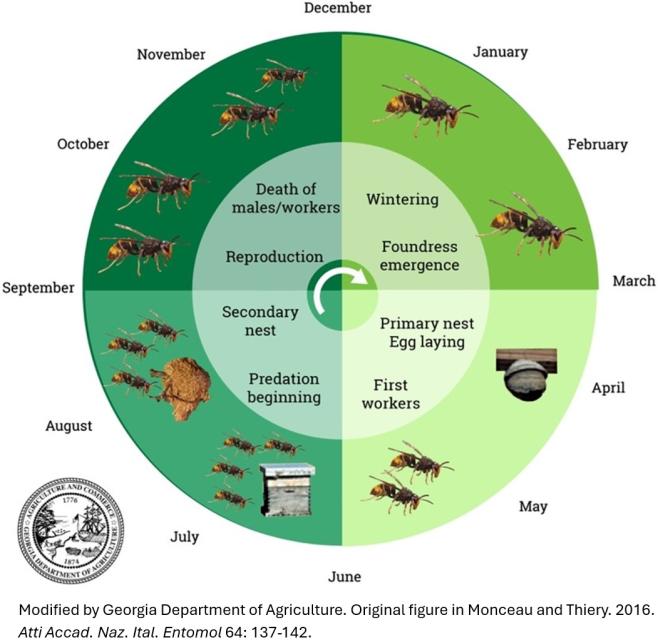
Life Cycle: Yellow-legged hornets become active early in the spring and build their populations over the summer months and into the fall. Queens emerge in early spring and build embryo nests (about the size of a tennis ball) to raise workers. As spring progresses into summer these nests grow into primary nests (can be as large as a volleyball), and the workers begin to forage for prey. Later in the summer secondary nests are constructed, usually high in treetops. These nests can be large (larger than a basketball) and contain hundreds of workers. Reproductive larvae (females and males) are produced and reared during this time. In the fall, males mate with new queens. Through the fall and into the winter months, the workers and males die out, leaving only the reproductive queens to overwinter and start new nests the following spring.
What's Out Now?
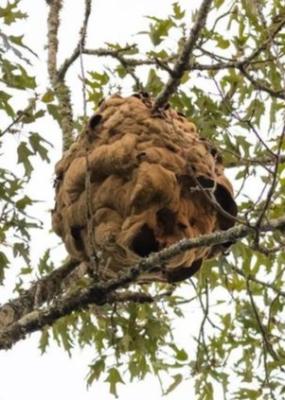
Pictured above is a secondary nest of the yellow-legged hornet. Secondary nests are constructed in the late summer through the fall to accommodate the growing colony. They are usually found at least 33 feet above ground in trees.
Look Alikes: There are a number of other insects, especially wasps and hornets, that are commonly mistaken for yellow-legged hornet. Please check out the documents below to see some of these common look-alikes:
If you think you have seen yellow-legged hornet, please take a photo (and try to include a size reference such as a quarter or pen) and upload it with our Yellow-Legged Hornet Reporting Tool.
When submitting a report please include the location of the sighting, the date, and your contact information.
Set Home Traps to Assist with YLH Survey: Although NCDA&CS-Plant Industry Division and USDA-APHIS-PPQ are surveying in North Carolina for yellow-legged hornet, beekeepers and residents are encouraged to set, report and monitor home traps to strengthen our statewide surveillance for new YLH populations. Homemade traps are easy to make and should be set in March (to trap for new queens) and/or May (to trap for workers) and monitored every one to two weeks. Trapping can be conducted until the first frost in the fall. More information on how you can help us look for yellow-legged can be found at this link.
Useful Links
NCDA&CS Apiary Field Services: Apiary Inspectors
NC Cooperative Extension YLH Found In Georgia
NC Cooperative Extension Side by Side Comparison
Georgia Department of Agriculture