Plant Industry - Emerald Ash Borer
The North Carolina statewide Quarantine for EAB has been officially repealed!
However, other states may still have exterior quarantines with their own list of regulated articles. Ash plant and product producers, and firewood producers may still need certification from NCDA&CS (see the FAQ on EAB Quarantine & Compliance Agreements).
About Emerald Ash Borer
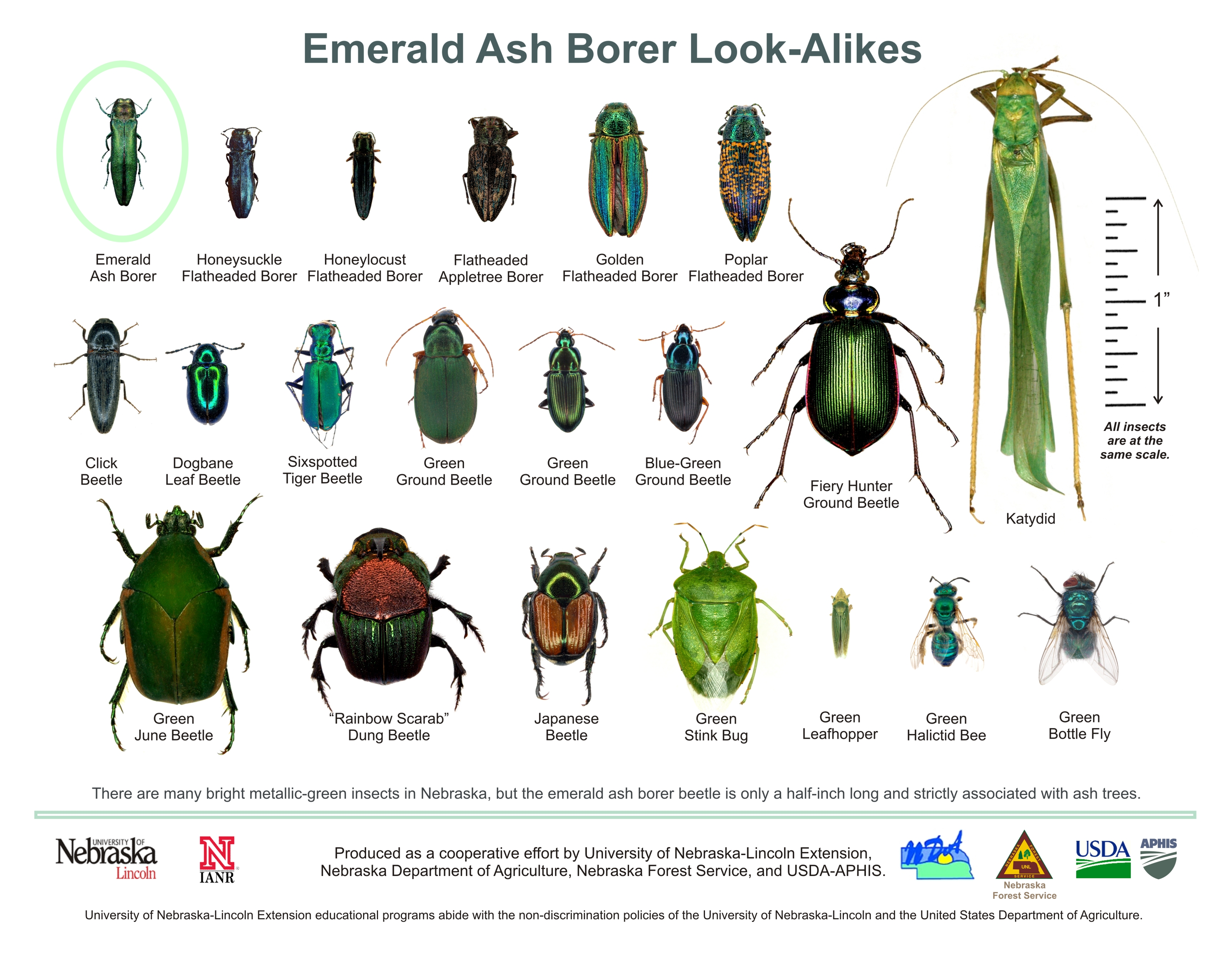
The emerald ash borer (Agrilus planipennis Fairmaire; EAB) is a metallic-green beetle that bores into ash trees (Fraxinus sp.), ultimately killing them. The beetle is not native to the United States and was first detected in the United States near Detroit, Michigan in 2002. Since then, the beetle has been detected in Quebec and Ontario and 35 states in the US, including North Carolina in June 2013.

| 
|
| David Cappaert, Michigan State University, Bugwood.org | Howard Russell, Michigan State University, Bugwood.org |
EAB lay their eggs on the bark of ash trees. When the eggs hatch, the larvae bore through the bark and into the cambium and feed on the transportation tissues, which disrupts the movement of nutrients and water within the tree, eventually killing the tree.
Adult EAB can fly at least ½ a mile from the tree where they emerge, but are more commonly spread when humans move infested materials such as nursery stock, logs, and firewood into uninfested areas. Symptoms of EAB in ash trees include a general decline in the appearance of the tree, such as thinning from the top down and loss of leaves. Clumps of shoots, also known as epicormic sprouts, emerging from the trunk of the tree and increased woodpecker activity are other symptoms.
Emerald ash borers overwinter as larvae. Adult beetles begin to emerge from May to June and can be found in the summer months. The adult beetle is ¼ to ½-inch long and is slender and metallic green. When the adults emerge from a tree, they leave behind a D-shaped exit hole. The larvae can also create serpentine tunneling marks, known as feeding galleries, which are found under the bark of the infested trees.

| 
|
D-shaped exit hole | Serpentine galleries under bark |
| David Cappaert, Michigan State University, Bugwood.org | William M. Ciesla, Forest Health Management International, Bugwood.org |
EAB was first detected in North Carolina in Granville County in June 2013 and was subsequently found in Person, Vance and Warren counties. In March 2015, EAB was found in a stand of ash trees in Wayne County. Two more EAB detections occurred in June 2015--one in Franklin County as a result of the Cerceris fumipennis Biosurveillance Program and the other in Wake County from a purple prism trap. During trap pull in July and August 2015, the beetle and evidence of its life stages were discovered in counties throughout the state. As a result of the widespread presence of EAB in North Carolina, Commissioner Troxler signed an emergency order placing the entire state under quarantine for emerald ash borer in 2015. The federal quarantine for EAB was lifted in 2021, and the state quarantine was repealed in 2026. Many states still have exterior quarantines that impact the movement of firewood and ash products from North Carolina (see FAQ on EAB Quarantine & Compliance Agreements).
I have EAB in my trees, but do not need a compliance agreement. What should I do?
The N.C. Forest Service - Forest Health Section is still tracking the spread of Emerald Ash Borer as it approaches the coast. Check their map to see the if your county has a confirmed infestation.
Home and landowners in uninfested counties are encouraged to report any symptomatic activity in ash trees to their local N.C. Forest Service County Ranger. Within EAB infested areas, any non-treated ash trees that are still thriving should be reported to help us preserve native ash species. Rangers can also suggest treatment options for homeowners: contact your NCFS County Ranger
For information regarding selecting and applying a pesticide to treat or protect ash trees from EAB, please read the Emerald Ash Borer Insecticide Guide produced by the N.C. Forest Service.