
Plant Industry - Spotted Lanternfly
Spotted Lanternfly

Where was the Spotted Lanternfly Found?
Select the county where you observed the spotted lanternfly.
Guilford,
Forsyth, or
Davidson County
Spotted lanternfly is established in these counties. Visit the NC State Extension page for identification, management, and the latest information.
Any Other
North Carolina
County
Reports from counties outside the established infestation area help track the spread of spotted lanternfly in North Carolina.
Spotted lanternfly, Lycorma delicatula, is an invasive planthopper that was first detected in the United States in Berks County, Pennsylvania, in 2014. Since then, the pest has been detected in over 18 states. Reproducing infestations of this pest have been found throughout Pennsylvania as well as portions of Connecticut, Delaware, Georgia, Illinois, Indiana, Kentucky, Maryland, Massachusetts, New Jersey, New York, Ohio, Rhode Island, Tennessee, South Carolina, Virginia, and West Virginia. The first live population of spotted lanternfly was found in Forsyth County, North Carolina near the border with Guilford County in June 2022, in Reidsville (Rockingham County) and Lenoir (Caldwell County) in spring 2025. These are currently the only known populations of this pest in the state.
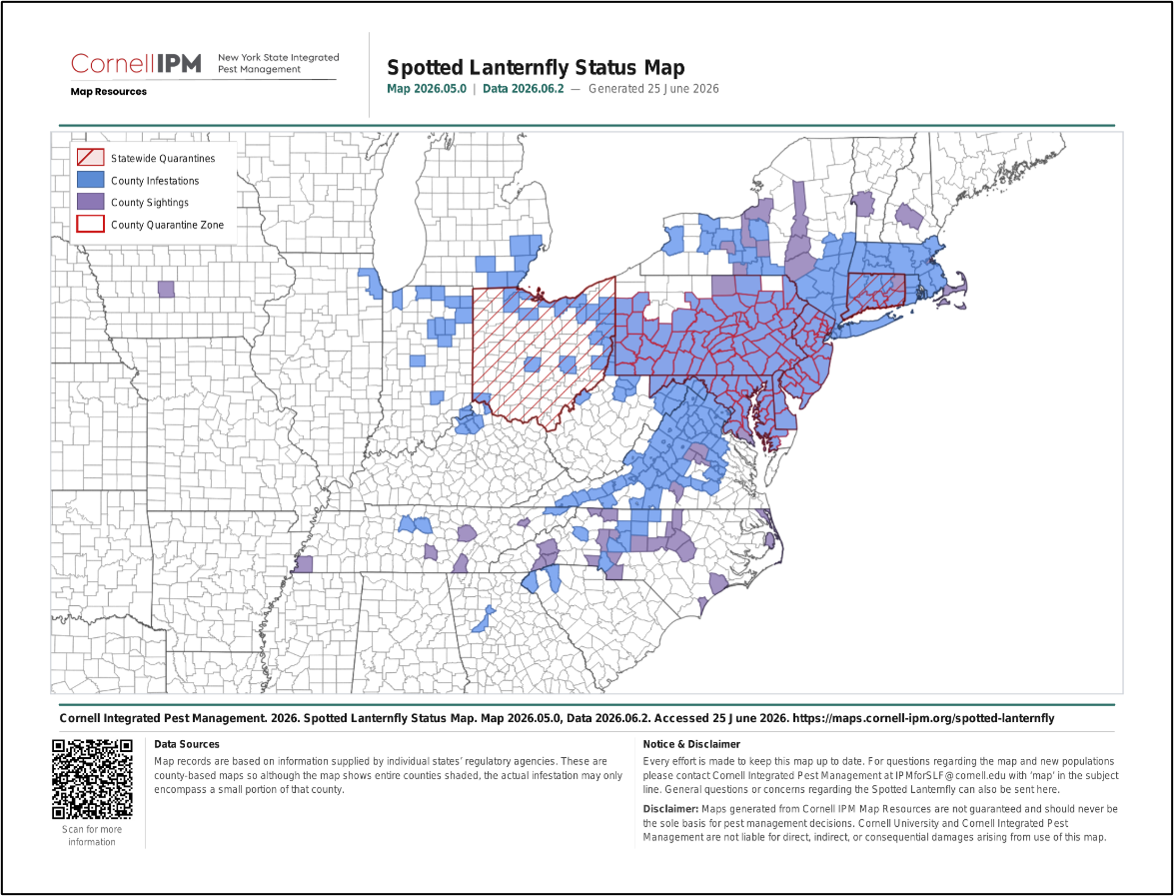
(Image courtesy of New York Integrated Pest Management, Cornell University)
Spotted lanternfly is a piercing-sucking insect that produces large amounts of honeydew while feeding. This buildup of honeydew attracts stinging insects like wasps and ants and can cause black sooty mold to grow on infested plants as well as homes and businesses, reducing property values. They are a known pest of over 70 species of plants including grapes, stone fruits, apples, maple, walnut, willow, chinaberry and tree-of-heaven. SLF overwinters in the egg stage, hatching into nymphs during Spring. There are four nymphal (instar) stages prior to becoming adults in Summer. The 4th nymphal stage (late instar) and adults show a strong preference for tree-of-heaven as their host.
| Egg Mass | Early Instars | Late Instar | Adult |
|---|---|---|---|

| 
| 
| 
|
| September to May | Late March to June | Late May to July | July to December |
| Each egg mass is ~1-inch in size and contains roughly 35 eggs | The 1st instar is small (roughly the size of a tick) and grows to ~1/4-inch size (3rd instars) | Bright red and ~1/2-inch in size | From head to wing tip ~1-inch in size |
If you think you have seen Spotted Lanternfly, please take a photo (and try to include a size reference such as a quarter or pen) and upload it with our reporting tool.
When submitting a report please include the location of the sighting, the date, and your contact information. If the insect got away, please take a picture of the location where you saw it.
Residents in western Guilford County and eastern Forsyth County do not need to report! The area is now unfortunately generally infested, and we are only able to treat commercially- and publicly- owned properties with a high risk of spread currently. If you see SLF at your home, please help us Stomp the Spread by contacting your County Extension Office and/or licensed pest control professional to create an SLF management plan that works best for your home.
There are a number of native insects that are commonly mistaken for spotted lanternfly. Please check out the look-alike documents below to see some of these common look-alikes:
- Spotted Lanternfly Adult Look-alikes
- Spotted Lanternfly Nymph Look-alikes
- NC Spotted Lanternfly Look-Alikes
Activities for the Kids
- Spotted Lanternfly Origami (Select "Fit to printable area" when printing)
- SLF Search & Find and Fun Facts Sheet
Useful Links
- Gardening - NC Cooperative Extension Spotted Lanternfly Resources Page
- General - NC Cooperative Extension SLF Resources Page
- Connecticut Department of Energy and Environmental Protection
- Delaware Department of Agriculture
- Georgia Department of Agriculture
- Illinois Department of Agriculture
- Indiana Department of Natural Resources
- Kentucky Office of the State Entomologist
- Maryland Department of Agriculture
- Massachusetts Department of Agricultural Resources
- Michigan Department of Agriculture and Rural Development
- New Jersey Department of Agriculture
- New York Department of Agriculture
- New York State IPM Center
- Ohio Department of Agriculture
- Pennsylvania Department of Agriculture
- Rhode Island Department of Environmental Management
- Tennessee Department of Agriculture
- South Carolina – Clemson Department of Plant Industry
- Virginia Department of Agriculture
- West Virginia Department of Agriculture
- USDA-APHIS-PPQ: SLF Main Page
- USDA-APHIS-PPQ: Educational Resources