
Plant Industry - Spongy Moth Introduction
Spongy Moth Introduction and Life Cycle
Spongy moth (Lymantria dispar, formerly gypsy moth) is a European forest pest that feeds on the leaves of over 300 different species of trees in North America. The damaging stage is the larval or caterpillar stage. Larvae have been known to consume up to one square foot of leaves each by the time they reach maturity.
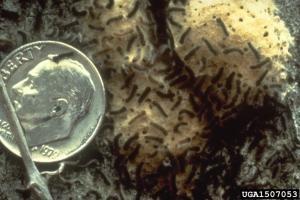
Forestry Images
The spongy moth life cycle starts when the larvae hatch in the spring. Hatch usually occurs shortly after oak foliage begins to expand. Larvae often remain on the spent egg masses until a warm day arrives, at which time they journey to the foliage and begin eating.
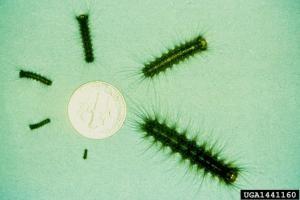
Forestry Images
Larval growth is categorized by instar, of which there are five or six. Molting, the process where the caterpillar sheds its exoskeleton so it can grow larger, defines the transition between each instar. Male spongy moth caterpillars go through five instars, while females go through six. Each instar lasts roughly two weeks, depending on weather.
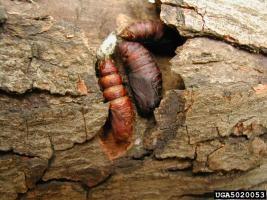
Spongy moths then move into pupation by transforming into a cocoon and spinning a thin web of silk around themselves. Male and female pupae differ in size and coloration. This phase lasts roughly three weeks.
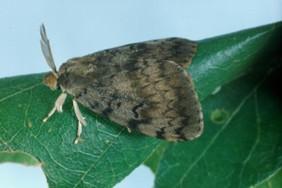
Upon completion of pupation, the spongy moth splits the cocoon to emerge. The male emerges first, several days prior to emergence of the female.
The female of the European spongy moth is flightless (females of the flighted spongy moth complex are able to fly; NC had a serious infestation that was eradicated in 1994. Moths of these subspecies are surveyed for through the Asian Defoliators survey in our CAPS program. Adult spongy moths do not feed; their sole function is to reproduce. Once the female emerges, she is sexually mature, and almost immediately begins releasing sex pheromone to attract male moths.
Male moths use this pheromone to locate the female moth. After mating, the female lays an egg mass, usually composed of between 300 and 1000 viable eggs. Both the female and male moths die shortly after mating.