
N.C. Forest Service - Lightning-induced Wildfires
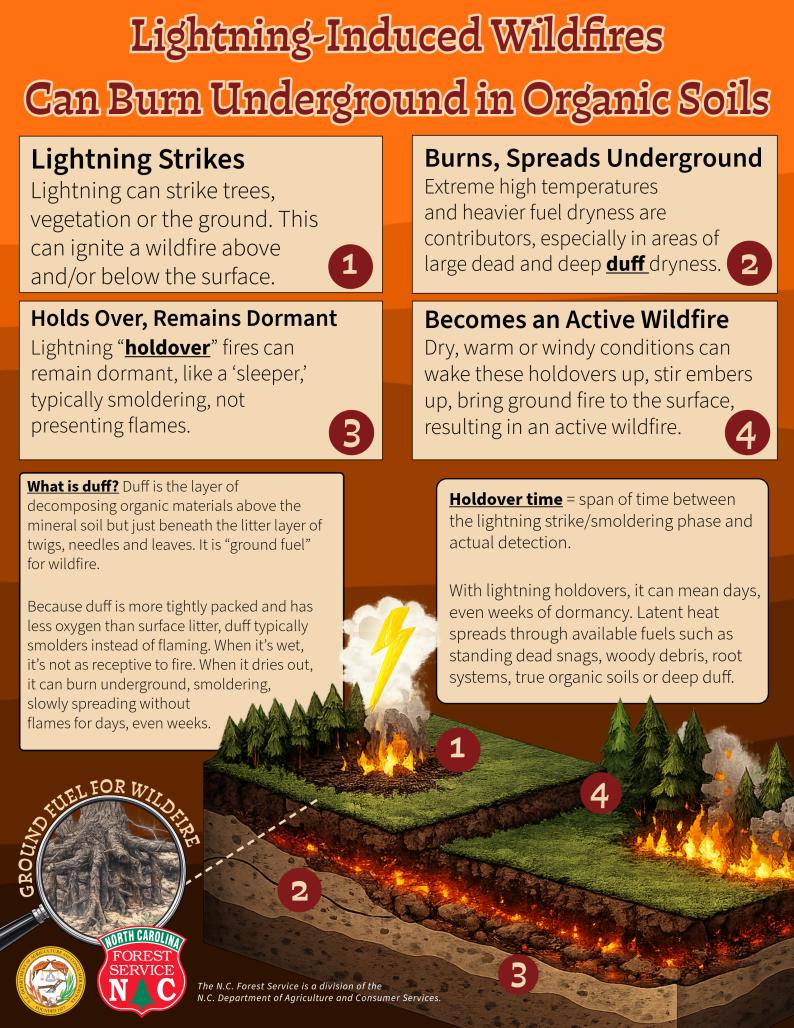
Lightning-induced wildfires can burn underground in organic soils.
With prolonged drought and lack of wetting rainfall, lightning ignition efficiency is enhanced. This means there is a greater probability that cloud-to-ground lightning strikes ignite a wildfire. Lightning can strike trees, vegetation or the ground, igniting a wildfire above and/or below the surface. Extreme high temperatures and heavier fuel dryness are contributors, especially in areas of large dead and deep duff dryness.
What is duff? Duff is the layer of decomposing organic materials above the mineral soil but just beneath the litter layer of twigs, needles and leaves. It is “ground fuel” for wildfire. Because this duff is more tightly packed and has less oxygen than surface litter, duff typically smolders instead of flaming. When it’s wet, it’s not as receptive to fire. When it dries out, it can burn underground, smoldering, slowly spreading without flames for days, even weeks.
This type of wildfire is not new or uncommon to North Carolina. Both Evans Road in 2008 and Pains Bay in 2011 were lightning-induced wildfires in the Coastal Plain, an area rich with organic soils. These fires ignited during periods of persistent and prolonged drought, burned for weeks and consumed more than 40,000 acres each.
Lightning “holdover” fires are wildfires that can remain dormant, like a ‘sleeper,’ typically smoldering underground, not presenting flames. Holdover time would generally be defined as the span of time between the lightning strike/smoldering phase and actual detection. With lightning holdovers, it can mean days, even weeks of dormancy. Latent heat spreads through available fuels such as standing dead snags, woody debris, root systems, true organic soils or deep duff.
Dry, warm or windy conditions can wake these holdovers up, stir embers up, bring ground fire to the surface and result in an active wildfire.
This page was last modified on 08/06/2026