
Understanding Your Media Report
Nitrogen (N)
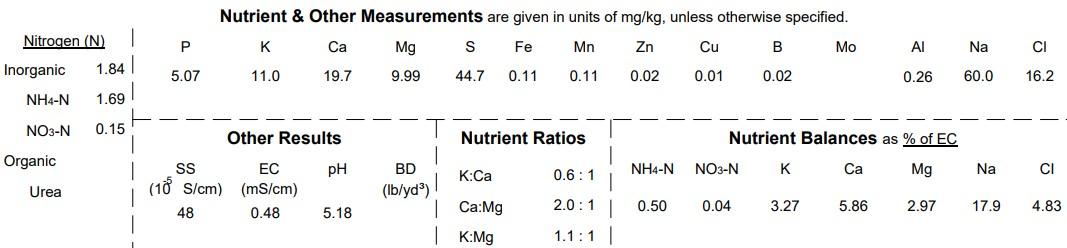
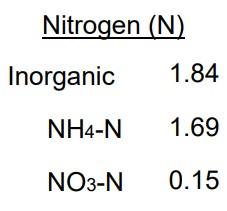
Total concentration of inorganic nitrogen and the individual concentrations of inorganic nitrate-nitrogen (NO3-N) and ammonia-nitrogen (NH4-N). Results are reported in mg/kg which is equivalent to parts per million (ppm).
Other Nutrients
Concentrations of inorganic phosphorus (P), potassium (K), calcium (Ca), magnesium (Mg), sulfur (S), iron (Fe), manganese (Mn), zinc (Zn), copper (Cu), and boron (B) are reported in mg/kg which is equivalent to parts per million (ppm).
Sodium (Na) and chloride (Cl) are elements that may be important for plant nutrition but are more often detrimental to plant health in excessive levels. Aluminum (Al) is not a plant nutrient and may create toxicity when media substrate pH is excessively low. Aluminum also plays a role in coloration for ornamental crops such as hydrangea.
Other Results
EC (Electrical Conductivity) is reported in units of mS/cm. It measures the total quantity of dissolved salts (ions) in the growing media. It may be used as a general evaluation of the total nutrient concentrations available to plants. However, it also includes elements such as sodium (Na) and chloride (Cl), which increase EC without providing nutritional value. In addition, excessively high EC will burn plant roots regardless of whether the ions are required for plant nutrition.
SS (Soluble Salts) is the same as EC, but is expressed in units of 10-5 S/cm.
The pH is the level of acidity or basicity as measured by the amount of hydrogen ions (H+ ) in solution. It ranges from 0 (acidic) to 14 (basic) on a logarithmic scale; 7 indicates neutrality. It can reduce the availability of micronutrients (Fe, Mn, Zn, Cu,B) when pH is high (>6.5) and the availability of macronutrients (N, P, K, Ca, Mg, S) when pH is low (<5.0). It also impacts the efficacy of pesticides.
Bulk density (BD) is a measure of how heavy the soilless media is, relative to its volume. It is an optional test that is often used to determine pesticide application rates.
Nutrient Ratios
The balance between nutrients that are known to affect nutrient uptake when one element is at excessively high concentrations relative to the other. The nutrient ratios reported are potassium:calcium (K:Ca), calcium:magnesium (Ca:Mg) and potassium:magnesium (K:Mg).
Nutrient Balance
Expressed as a percentage of total soluble salts (EC). When the total salts in the growing media are comprised of excessively high concentrations of one nutrient, this can induce deficiencies of other nutrients. Also, when salts such as sodium (Na) and chloride (Cl) make up an excessive percentage of the total salts, plant damage is more likely.
This page was last modified on 06/15/2026