
Nutrient Measurements
The leaf tissue concentrations of nitrogen (N), phosphorus (P), potassium (K), calcium (Ca), magnesium (Mg) and sulfur (S) are reported in percent (%). The leaf tissue concentrations of the micronutrients iron (Fe), manganese (Mn), zinc (Zn), copper (Cu), and boron (B) are reported in mg/kg which is equivalent to ppm.
- Molybdenum (Mo) is a micronutrient that is important in certain crops with high Mo requirements. Molybdenum is automatically included in the standard analysis for Brassicas, poinsettia, alfalfa, and spinach. It may be requested for other crops.
- Nitrate-nitrogen (NO3-N) is a required test for strawberry and cotton petiole samples and is widely used to monitor and optimize nitrogen levels throughout the growing season. Growers may request this test for other crops but target recommendations are not provided for crops other than strawberry and cotton.
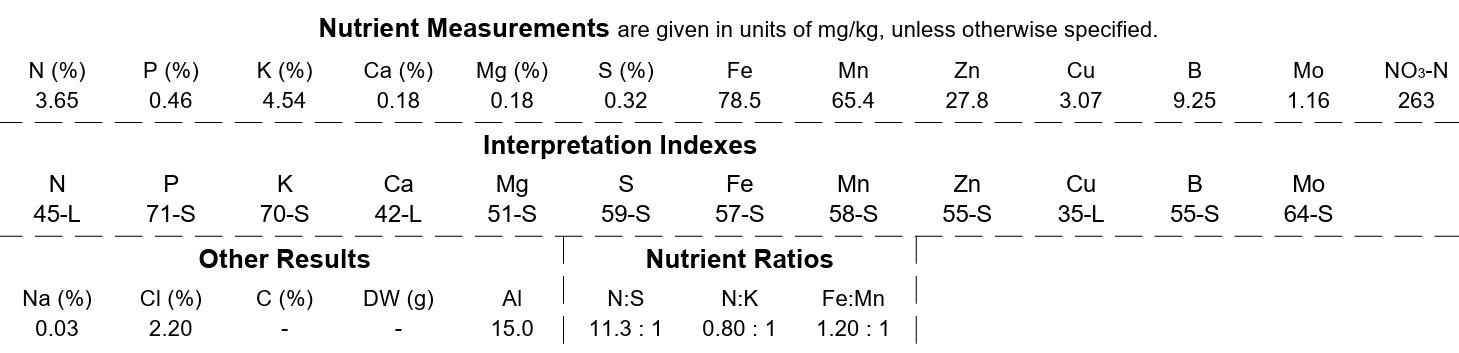
Interpretation Indexes
Each nutrient concentration is compared to the established sufficiency range for that nutrient in the specified crop, translated into a numerical index between 0 and 124, and assigned an alphabetic descriptor that categorizes the nutrient concentrations as either deficient (D), low (L), sufficient (S), high (H), or excessive (E). Concentrations with an index value from 0-24 are considered deficient; from 25-49 are low; from 50-74 are sufficient, from 75-99 are high and above 100 are excessive.
| Descriptor | Index Range | Example Scenarios/Actions |
|---|---|---|
| Deficient (D) | 0 -24 | Plant symptoms likely visible. Growth is likely affected. Corrective actions needed. |
| Low (L) | 25 - 49 | Plant may be experiencing "hidden hunger". Symptoms may not be visible. Corrective actions may be suggested. |
| Sufficient (S) | 50 - 74 | Plants are growing well. No actions needed. |
| High (H) | 75 - 100 | Plants are likely growing well. If multiple nutrients are excessive or high, may need to cut back on feed rates. |
| Excessive (E) | 101 - 124 | Plants may be experiencing toxicity at this level. Plant symptoms may occur. Cut back on feed rates. |

Where do we get our sufficiency ranges?
Our plant sufficiency ranges come from many sources. Many of our ranges are from high-yielding crop surveys and peer-reviewed research. Others are calculated from years of sample submissions; grouping grower reported symptoms to tissue concentrations. Any growth symptoms reported on the submission paperwork is very helpful and appreciated and allows us to improve our sufficiency ranges and interpretations. For plants that are not well researched, general ranges are provided from plants of similar species, growth, or habit.
What is "Hidden Hunger"?
Hidden hunger is when a crop lacks an essential nutrient, but does not have any visual symptoms. This crop will have reduced yields but will otherwise look healthy. The only way to catch hidden hunger and prevent deficiency is tissue testing.
Other Results and Nutrient Ratios
Sodium (Na) is included in the standard analysis and reported in percent (%). It is rarely an element of concern in plant tissue concentrations but may have large impacts on root and soil health, as determined by corresponding soil tests.
Chloride (Cl) is analyzed only by request on the submission form and reported in percent (%). It is of primary concern in coastal areas where salt water intrusion may impact field irrigation or fertigation source water quality or where greenhouse operations have high Cl in source water, nutrient solutions, or soilless (potting) media.
Aluminum (Al) is not a plant nutrient and is reported in ppm (mg/kg). It is rarely an element of concern in plant tissue concentrations but may have large impacts on root and soil health, as determined by corresponding soil tests. It is also used in horticulture to evaluate coloration of hydrangeas.
Nitrogen to sulfur ratio (N:S) is of primary nutritional concern in corn and small grains (e.g. wheat, barley, rye, oats, etc.) and strawberries. Excessively high ratios (> 18:1) may induce sulfur deficiency even where soil sulfur is adequate.
Nitrogen to potassium ratio (N:K) is rarely a concern except where N concentrations are extremely high.
Iron to manganese ratio (Fe:Mn) is rarely a concern in field crops and occasionally a problem in greenhouse operations where excessive iron may induce manganese deficiency.
This page was last modified on 05/12/2026