StRAP Applications
StRAP is not currently accepting applications.
The application window for projects associated with Hurricane Helene has closed. Additional funding may be available in the future, and updates will be posted on this page as they becomes available.
StRAP Applications are currently closed
The application window for projects associated with Hurricane Helene is closed. Learn more about organizations awarded funding here.
Read the full funding announcement here.
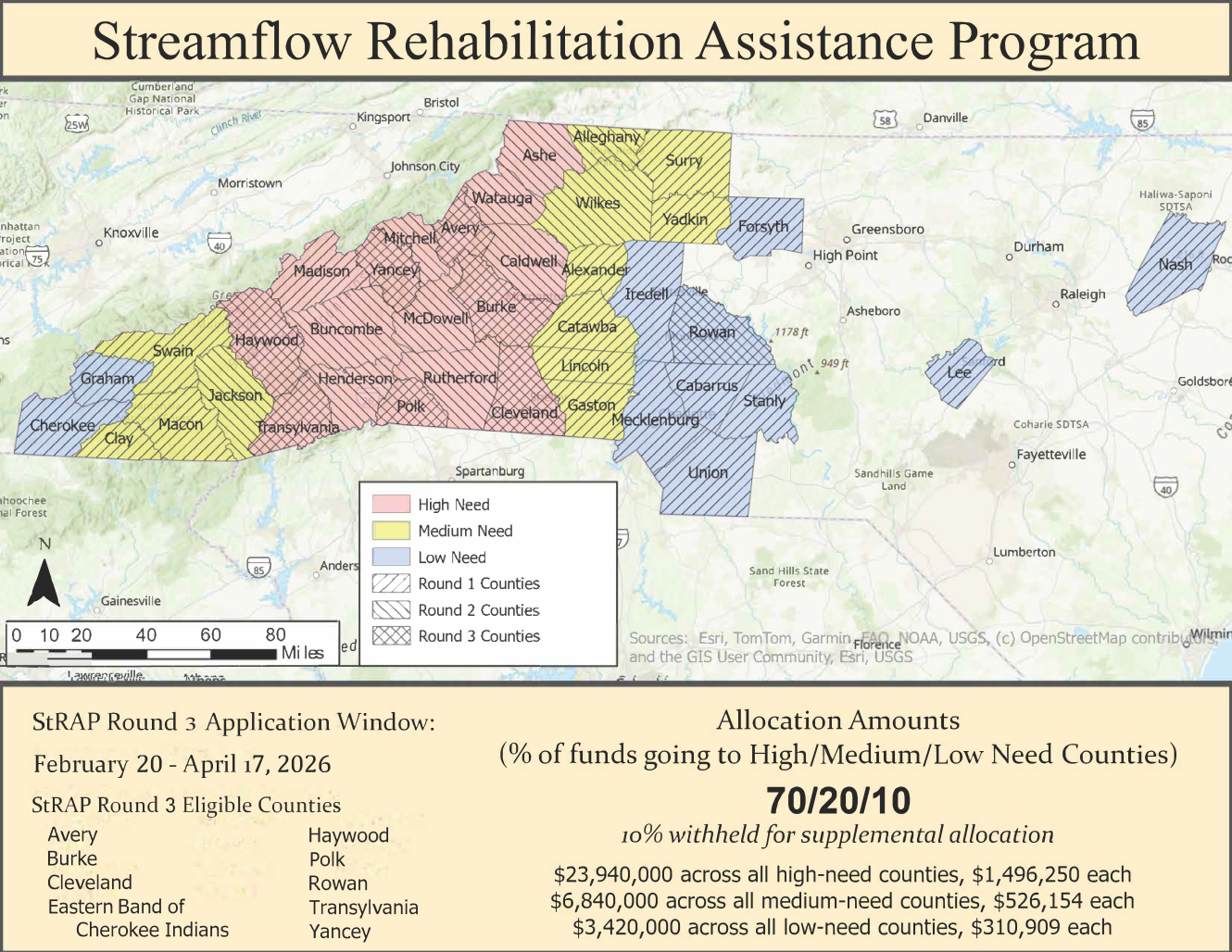
Counties with projects eligible for Helene funding are shown below:
Site Eligibility:
This funding is aimed at repairing stream damage caused by Hurricane Helene. Stream issues that pre-date Hurricane Helene, or were caused by other events, are not eligible for StRAP funding. However, if applicants can document that pre-existing stream damage was significantly increased by Hurricane Helene, that site could be eligible for StRAP funding.
The following organizations are eligible to apply for StRAP funding:
• Soil & Water Conservation Districts
• Political subdivisions (city/county government, water/sewer district, municipal service District, sanitary district, drainage district)
• Non-profit organizations
We will accept applications from eligible organizations in the 39 counties (and Eastern Band of Cherokee Indians) identified by the FEMA disaster declaration for Hurricane Helene.
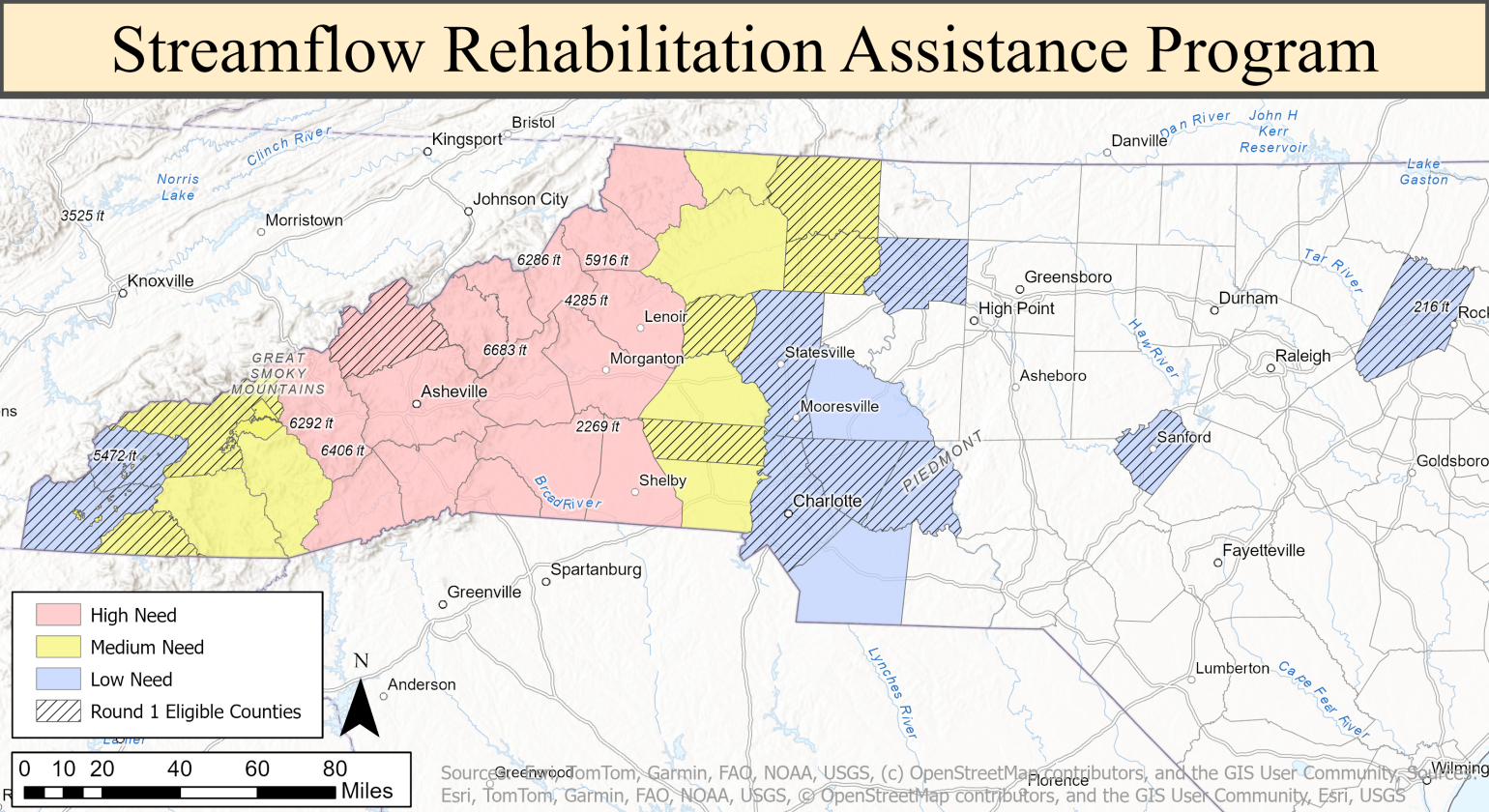
Counties are divided based on total impact, with 70% of funds allocated for High-need counties, 20% for medium-need counties, and 10% of funds for low-need counties. The breakdown of counties in each category is available on the map below.
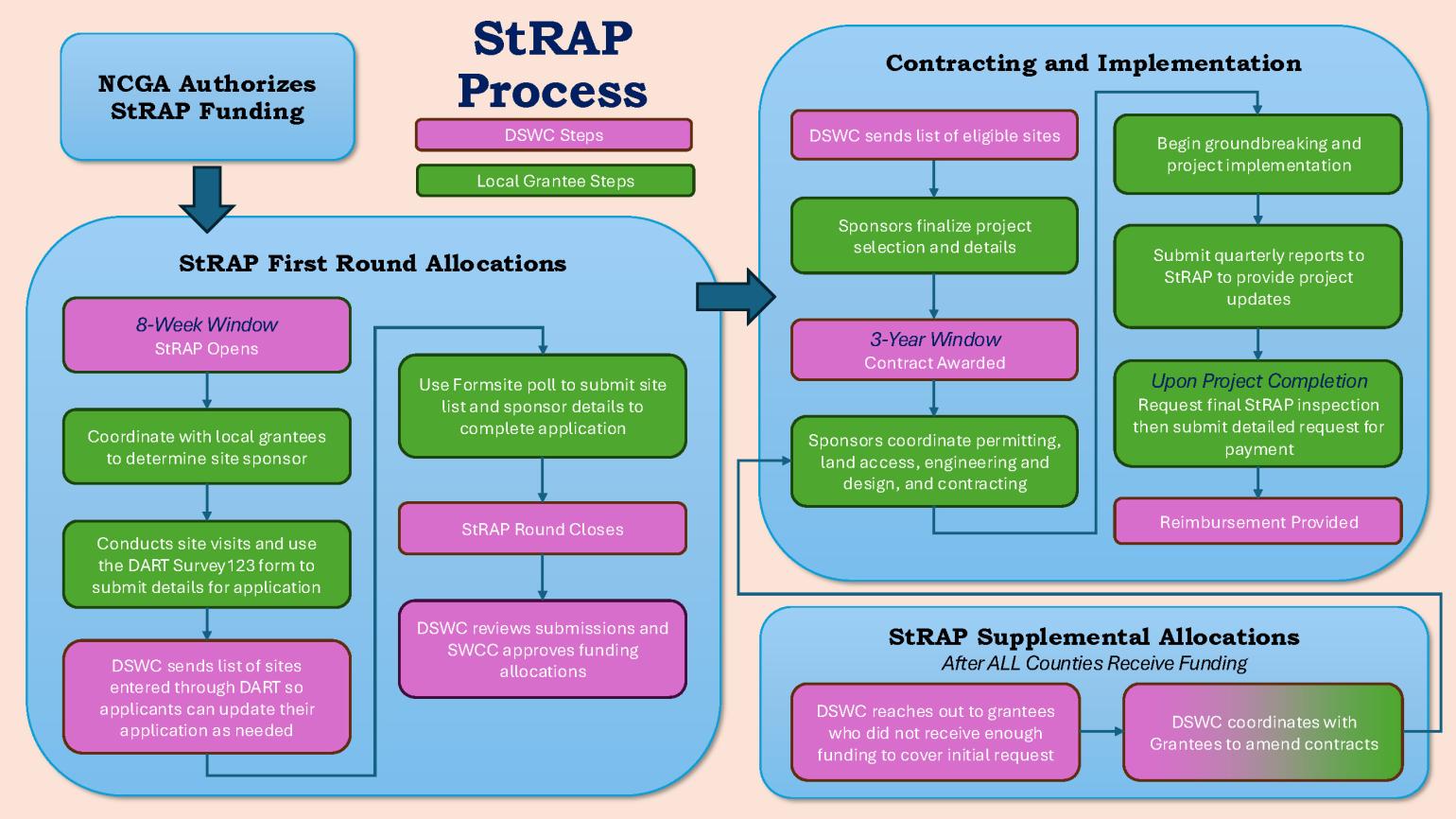
StRAP will begin accepting applications on a rolling application process, with counties becoming eligible to apply for StRAP funds once all EWP enrollment in that count is completed (or if no organizations in the county are applying for EWP). StRAP staff will post information announcing when organizations in each county can apply for funding. Once an application window begins, organizations in that county (or counties) will have 8 weeks to submit applications. Please pay attention to updates on the StRAP website for more information.
1st Application Window (December 8, 2025 - February 20, 2026) includes the following counties: Alexander, Cabarrus, Catawba, Cherokee, Clay, Forsyth, Gaston, Graham, Iredell, Lee, Lincoln, Macon, Madison, Mecklenburg, Nash, Stanly, Surry, Swain, Union, Yadkin
2nd Application Window (January 15 - March 13, 2026) includes the following counties: Alleghany, Ashe, Buncombe, Caldwell, Jackson, McDowell, Mitchell, Rutherford, Watauga, Wilkes
3rd Application Window (February 20 - April 17, 2026) includes the following counties: Avery, Burke, Cleveland, Eastern Band of Cherokee Indians, Haywood, Henderson, Polk, Rowan, Transylvania, Yancey
The application has 2 steps:
Submit sites using the Disaster Assessment & Reporting Tool (DART). Use the links on the StRAP Disaster Response page to download and use DART, and learn how to use DART here.
Once the application window for your county begins, use DART in the field or the office to submit information on each stream segment to be included in your application, including site location, description of damage and planned repair, photos, and cost estimate.
Each different stream segment/project will be a separate entry in DART.
Please note that once a stream segment is submitted in DART, you cannot edit the entry. If corrections need to be made, please resubmit the stream segment as a new entry in DART.
Any sites submitted after your county's application window closes will not be considered.
Formsite- Once you have finished submitting all the sites you want to be considered as part of you application, fill out the linked Formsite poll to complete your application.
If any sites need to be removed from your application (EX: site was funded by another funding source, landowner completed work on their own, etc), you can list sites for removal on the Formsite Poll.
Access Formsite form.