
Agronomic Services - Nematode Management in Apple
Species and Prevalence
Several species of microscopic nematodes damage apples in North Carolina. These parasites feed on small feeder roots, inhibiting nutrient and water uptake. They also increase susceptibility to root diseases.
Among nematode pests of apple, lesion (Pratylenchus spp.) and dagger (Xiphinema americanum) are the most common, although root-knot, stubby-root, ring, sheath, needle, pin, spiral and stunt are also encountered often in our assay. In the mid-1990s, NCDA&CS conducted a survey of established and recently replanted apple orchards in five western North Carolina counties. Of 51 samples collected, 85% tested positive for lesion and 78% for dagger nematodes; 20% of the samples contained moderate to high numbers of one or both species.
Nematode Damage
Established Orchards. Nematode damage produces no definitive symptoms in established trees. Apple yield and quality tend to be reduced, and trees grow less vigorously. Some leaf chlorosis (yellowing) may occur. The root system is usually restricted, and feeder roots are often absent. Even when most of the trees in an orchard are infected, damage tends to vary from tree to tree.
Replanted Orchards. Nematodes are a component of apple replant disease, which is typified by poor growth and, in some instances, death of young trees. In heavy, poorly drained soils, nematodes are seldom the principal causal factor; however, in light, well-drained soils, they play a greater role. Damaged trees often have unsound root systems and can be easily pushed over.
Taking Nematode Samples
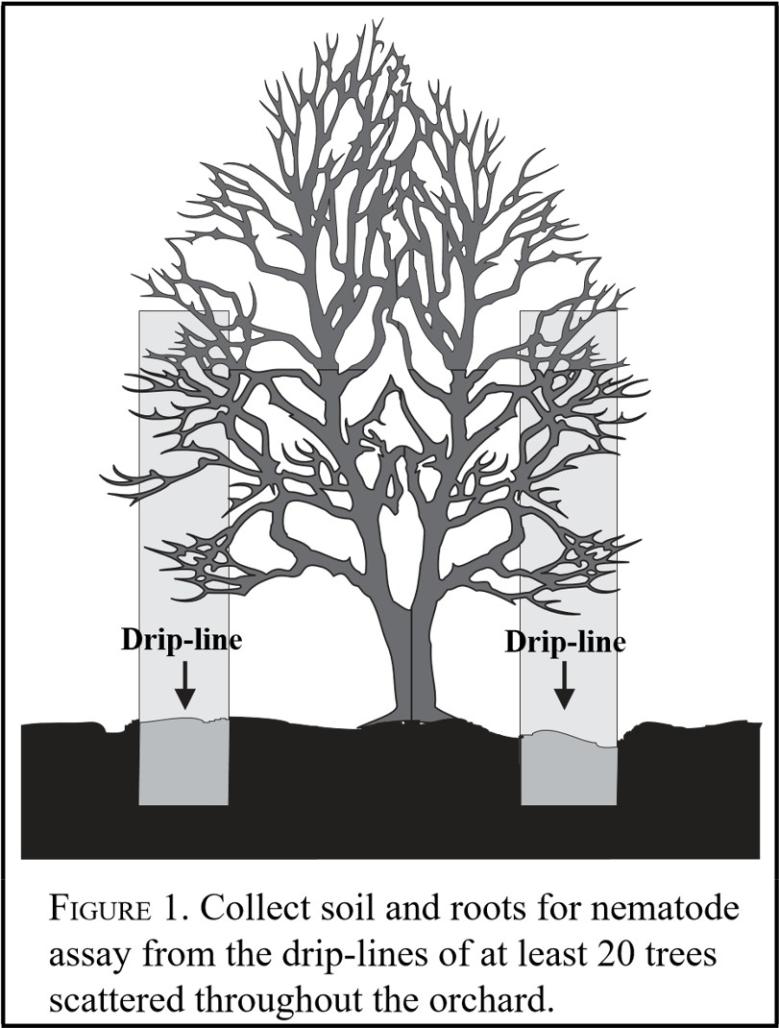
Microscopic analysis (assay) of soil and root samples is the only way to detect nematodes in apple orchards. Dagger nematodes are usually found in root-zone soil, while lesion nematodes are usually found inside the roots. Detailed instructions are available on the NCDA&CS diagnostic sample collection page. Taking a representative nematode sample involves collecting more than a quart of soil and roots from the drip-line of at least 20 trees scattered throughout the orchard (Figure 1). Sample material should be collected to a depth of 8–10 inches. Feeder roots must be included. A soil probe is the best tool for collecting soil; a trowel or spade is best for collecting roots. It is important to mix the collected material well before filling the plastic sample bag. The best time to sample is in March or April after the start of new feeder growth.
Nematode Management
Nematode assays are an essential management tool. They are the only way to find out if apple-damaging species are present and, if so, whether these species are present at critical population levels. Without the information assays provide, rational control strategies are impossible.
Established Orchards. In North Carolina, Vydate and Basamid are labeled for use against insects on established apples. These pesticides also have nematocidal effects and can increase orchard yield.
Replanted Orchards or New Plantings. Trees planted in fumigated areas grow faster and yield more than those in nonfumigated plantings. In replanted orchards, preplant fumigation also increases tree survival rates. Orchards treated with a broad-spectrum fumigant yield better than those treated with a nematicide alone, thus indicating that nematodes are not the sole cause of replant problems.
Nematode Testing Sites
Collaborative test-plot research conducted by NCDA&CS, N.C. Cooperative Extension and the NCSU Plant Pathology Department compared efficacy of two post-plant and two preplant nematicides. Preplant fumigation produced significant growth response in some apple varieties (Table 1). These findings should encourage use of a fumigant when replanting an orchard—especially if soil-borne diseases are present.
Always follow label instructions when applying pesticides.
Table 1. Preplant fumigation test, 1994.
| Variety | Treatment | Caliper | Height to node (Inches) | Height to terminal (inches |
|---|---|---|---|---|
| Red Fuji/M9/111 | Control | 0.80 | 41.80 | 63.29 |
| Red Fuji/M9/111 | Telone II | 1.25* | 58.20* | 96.20* |
| Empire/EMLA9 | Control | 0.60 | 40.80 | 64.60 |
| Empire/EMLA9 | Telone II | 0.51 | 45.29 | 65.43 |
| Gala/M26 | Control | 0.70 | 43.00 | 65.20 |
| Gala/M26 | Telone II | 0.75 | 44.80 | 78.50* |
| Jonagold/EMLA26 | Control | 0.70 | 43.00 | 65.20 |
| Jonagold/EMLA26 | Telone II | 0.75 | 44.75 | 78.50 |