
Agronomic Services - Nematode Management in Vegetables
Root-knot nematodes can cause major losses in vegetable crops, especially those grown in sandy soil and under late spring and summer conditions. Small to large root galls are evidence of these parasites (Figure 1) and can be readily observed on the roots of infected plants such as bean, pea, sweet potato, tomato and other summer season vegetables. Early spring-planted vegetables—such as beet, carrot, English pea, lettuce, potato and radish—can usually be grown in infested soils with limited damage.
Nematicides are available for commercial growers, but cultural practices— such as crop rotation, resistant varieties, and soil amendments—are the only management choices for the home garden. Root-knot nematodes attack so many plants that it is difficult to implement a good rotation. In general, homeowners can reduce root-knot populations in a garden plot by growing asparagus, fescue, onion, small grains, or marigolds in it for two to three consecutive years.
When possible, plant varieties that have resistance to root-knot nematodes. Resistant varieties actually suppress nematode populations to some extent. Tolerant varieties will grow in infested fields, but they do not suppress nematode populations and still exhibit some yield loss.
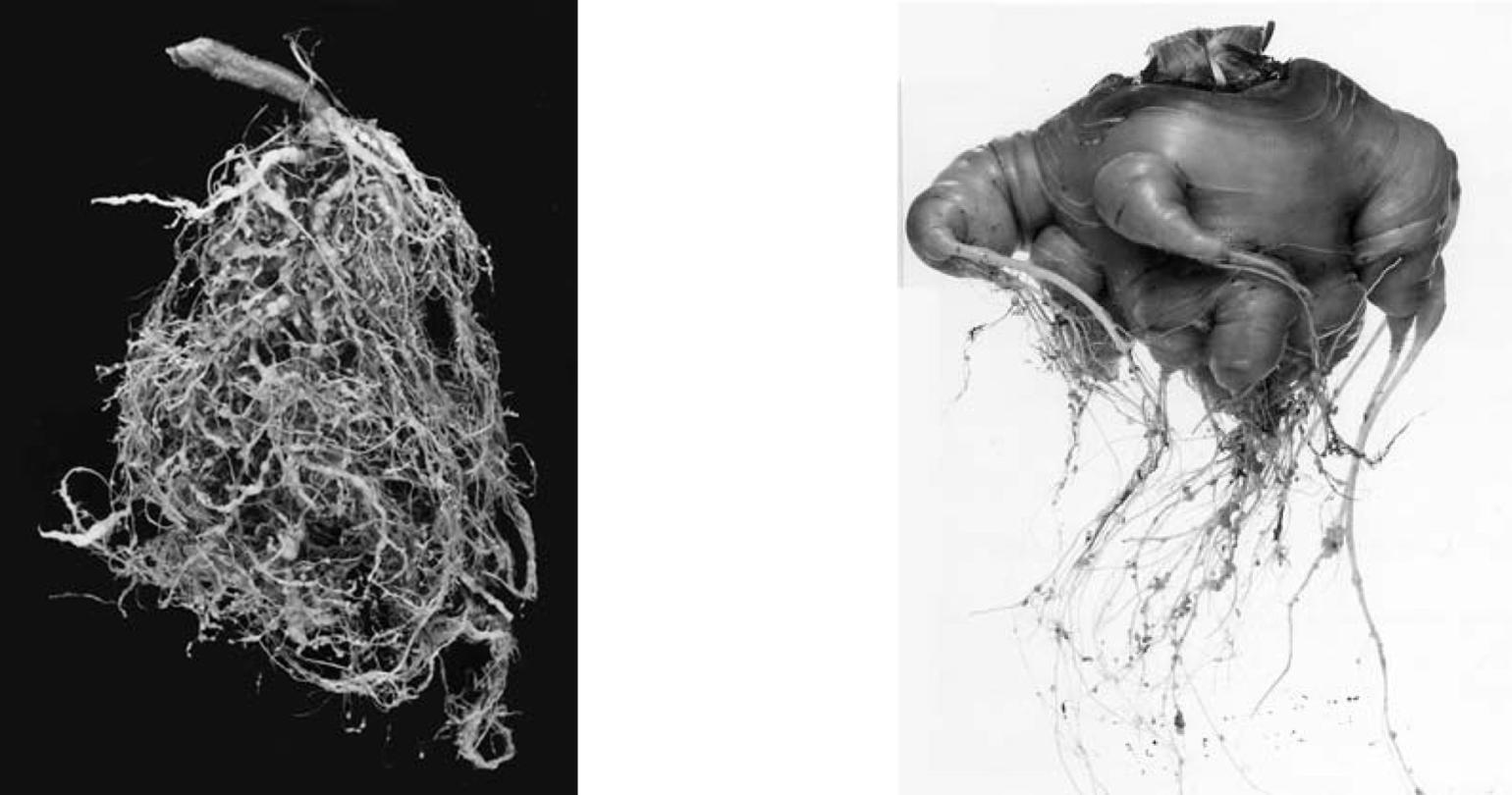
Figure 1. Root-knot damage to vegetables: tomato infected by Meloidogyne arenaria (left) and carrot infected by M. hapla (right).
A list of root-knot-resistant varieties is available from NC State Extension. As a rule, root-knot-resistant varieties are not resistant to all populations of this nematode. Therefore, it is a good idea to examine the crop roots at the end of the season. Look for root galls. If no galls are present, then the resistance is effective.
Because root-knot species differ in their ability to parasitize resistant varieties and rotational crops, identifying nematodes to the species level can help growers choose varieties or rotations suited to the species present. Growers submitting samples to the NCDA&CS Nematode Assay Lab can request root-knot species identification by selecting “Molecular Diagnosis” on the sample submission form.
Cultural practices can also be effective in reducing nematode populations:
- Removing residual crop roots immediately after harvest helps prevent nematode build-up.
- Tilling (hoeing, turning, cultivating) the soil two to four times in the fall allows sun and weather to diminish nematode populations.
- Incorporating organic matter into garden soil depresses nematode populations and increases water-holding capacity of soil and associated beneficial microbes.
- Planting marigolds in a vegetable garden helps control root-knot nematodes.