
Agronomic Services - Nematode Management in Sweetpotato
While several species attack sweetpotato, the southern root-knot nematode (Meloidogyne incognita) and guava root-knot nematode (M. enterolobii) are the most important in North Carolina and can cause yield loss, especially in sandy soils. They may also damage the quality of storage roots. On fibrous roots, these pathogens cause the formation of galls. On storage roots, symptoms may include galls, blister-like swelling or, in some instances, cracking (Figure 1).
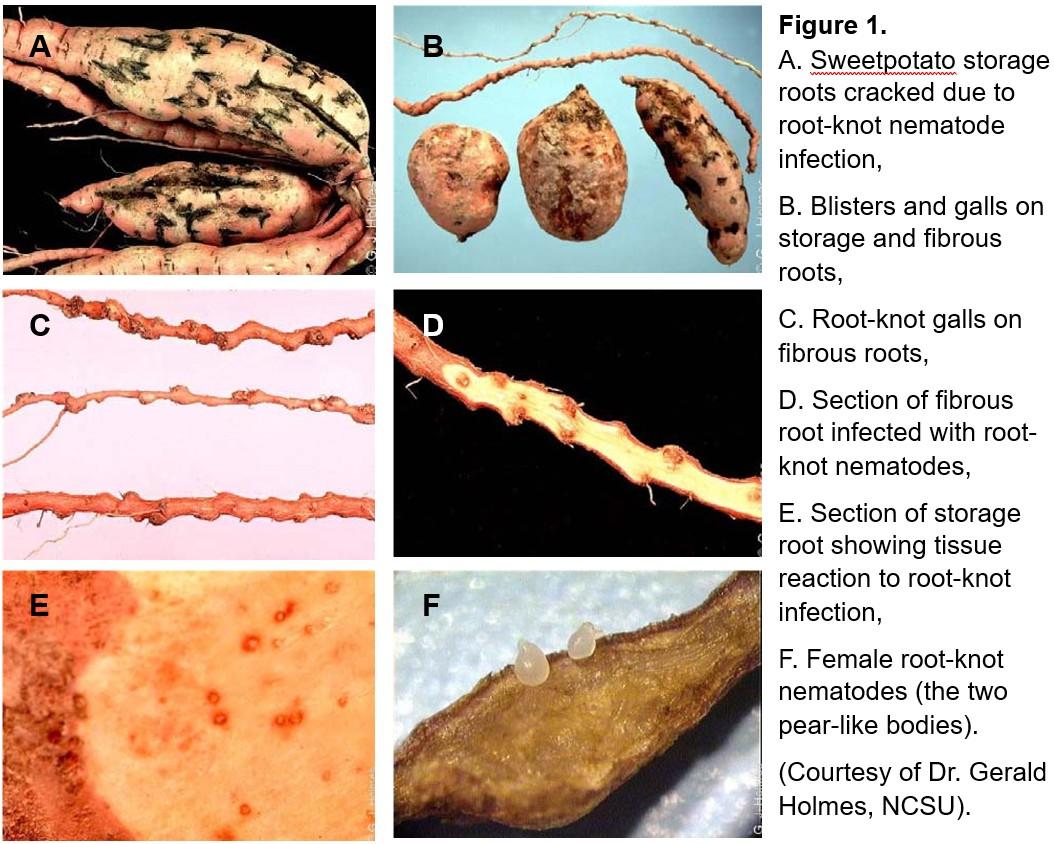
Root-knot nematodes are controlled by a combination of crop rotation, nematicides, and resistant cultivars. Knowing which species are present is essential, as some cultivars resistant to M. incognita are susceptible to M. enterolobii, and vice versa. A current list of species‑specific cultivar resistance is available from NCSU’s SweetARMOR program. Suitable rotation crops include grasses, peanut, and sorghum. Nematicides currently registered for use in commercial sweetpotato production are listed in NC State Extension’s Sweetpotato Root Knot factsheet. For details on usage of these nematicides, refer to the N.C. Agricultural Chemicals Manual and NCDA&CS pesticide registrations.
Other nematodes that parasitize sweetpotato include reniform (Rotylenchulus reniformis), lesion (Pratylenchus spp.), other root-knot species (M. arenaria, M. hapla and M. javanica), spiral (Helicotylenchus spp.), stunt (Tylenchorhynchus spp.), sting (Belonolaimus longicaudatus), dagger (Xiphinema spp.) and stubby-root (Paratrichodorus minor). Of these, the reniform nematode is reported to cause major losses to sweetpotato (poor root growth and cracking) in Louisiana but, as yet, has not been associated with economic damage to sweetpotato in North Carolina. Still, populations of reniform nematode are increasing here—particularly in counties with high cotton acreage.
There are no sweetpotato cultivars resistant to these other species of nematodes, so management depends on use of crop rotation and nematicides. Good rotation crops include grasses, corn, peanuts, small grain, sorghum, mustard, peppers and soybean (root-knot and reniform resistant). Weed control is also an essential management component because many weeds are excellent host plants for nematodes.
For more information, see: