
Agronomic Services - NemaNotes
Nematode Management in Soybean
Soybean cyst nematode is present. Soybeans and snap beans are the only host crops for this nematode that are commonly grown in North Carolina. Crop rotation is useful in managing soybean cyst nematode:
- year 1: nonhost crop
- year 2: cyst-resistant soybean variety
- year 3: nonhost crop
- year 4: cyst-susceptible soybean variety.
Growing small grains in winter is not equivalent to growing a nonhost crop for an entire year. If soybean cyst nematode populations are very high, grow nonhost crops for at least two consecutive years. Three years is even better. If high populations of cyst nematodes occur after a year of cyst-resistant soybeans, see Note 2-3.
This sample indicates an infestation of soybean cyst nematode. Take another sample from this field before planting soybeans or snap beans.
This sample indicates a high population of soybean cyst nematodes on or following a cyst-resistant variety. Therefore, currently available varieties with the same cyst-nematode resistance will probably not be effective against this population. Choose a variety with different resistance. See comments on managing nematodes on soybeans with resistant varieties following Note 2-6.
If possible, follow soybeans with nonhost crops for two consecutive years. After nonhost rotation, you can grow a susceptible soybean variety with lower risk of damage. If only a one-year rotation is possible, then consider the rotation schedule below. Planting a variety in maturity group V after June 15th may give acceptable yields.
- year 1: nonhost crop
- year 2 : soybean variety with a different resistance
- year 3: nonhost crop
- year 4: cyst-susceptible soybean variety
This sample indicates the presence of root-knot nematodes. Plant a resistant soybean variety this year to help manage the nematodes and prevent them from becoming a problem for future crops.
The information sheet did not indicate the variety of the previous soybean crop. If a cyst-resistant variety was used, it was not effective. Follow the suggestions in Note 2-3.
The information sheet did not provide complete cropping history. The sample indicates the presence of soybean cyst nematodes. If it has been two or more years since soybeans or snap beans were grown in the field, then these nematodes are not likely to damage next year's soybean crop. However, if these crops have been grown within the last two years, damage may be severe.
Nematode Management in Tobacco
Root-knot nematode populations are undetectable. A nematicide is not needed. However, a chemical treatment may be required to control soil-borne diseases, such as black shank or Granville wilt.
Root-knot nematodes are not likely to cause economic damage at this level. Use a resistant variety to prevent populations from increasing—unless the nematodes are already damaging a resistant variety. In that case, the usefulness of such varieties is limited. Other soil-borne diseases may still require chemical treatment.
Use a resistant variety OR a nematicide. However, if nematodes are already damaging root-knot resistant tobacco in this field, rely on a nematicide with a control rating of excellent. For information, consult the latest edition of the Flue-Cured Tobacco Guide published annually by the North Carolina Cooperative Extension Service. This publication contains ratings for recommended nematicide treatments. It is available from county Cooperative Extension offices as well as online.
Use a resistant variety AND a nematicide treatment. However, if root-knot damage has already occurred on resistant tobacco in this field, use a nematicide with a control rating of excellent. For information, consult the latest edition of the Flue-Cured Tobacco Guide published annually by the North Carolina Cooperative Extension Service. This publication contains ratings for recommended nematicide treatments. It is available from county Cooperative Extension offices as well as online.
Use a resistant variety AND a nematicide with a control rating of excellent. However, if nematodes are already damaging resistant varieties in this field, nematicide use is the only viable option. For information, consult the latest edition of the Flue-Cured Tobacco Guide published annually by the North Carolina Cooperative Extension Service. This publication contains ratings for recommended nematicide treatments. It is available from county Cooperative Extension offices as well as online.
The grower did not provide the name of the variety for the previous tobacco crop on the sample information form. If it was a resistant variety, it was ineffective. Use a nematicide with a control rating of excellent. For information, consult the latest edition of the Flue-Cured Tobacco Guide published annually by the North Carolina Cooperative Extension Service. This publication contains ratings for recommended nematicide treatments. It is available from county Cooperative Extension offices as well as online.
Currently available tobacco varieties with resistance to root-knot nematodes will not be effective in controlling this nematode population. Use a nematicide with a control rating of excellent. For information, consult the latest edition of the Flue-Cured Tobacco Guide published annually by the North Carolina Cooperative Extension Service. This publication contains ratings for recommended nematicide treatments. It is available from county Cooperative Extension offices as well as online.
Tobacco Beds: Use a soil fumigant regardless of the nematode population. It helps control weeds and soil-borne diseases.
The grower did not provide the name of the variety for the previous tobacco crop on the sample information form. If it was a resistant variety, it was ineffective, and you should not rely on its resistance in this field. Resample this field prior to planting tobacco, and use a nematicide with a control rating of excellent if the assay indicates the presence of root-knot nematodes. For information, consult the latest edition of the Flue-Cured Tobacco Guide published annually by the North Carolina Cooperative Extension Service. This publication contains ratings for recommended nematicide treatments. It is available from county Cooperative Extension offices as well as online.
In this case, root-knot nematode populations are relatively high on or following a root-knot resistant tobacco variety. Therefore, tobacco varieties with resistance to root-knot nematodes will be ineffective in this field. Sample this field again prior to planting tobacco and use a nematicide with a control rating of excellent if the assay indicates the presence of root-knot nematodes. Other nematodes that attack tobacco include the lesion nematodes (Pratylenchus species) and tobacco cyst nematodes (Globodera species) in limited areas of the state. For information, consult the latest edition of the Flue-Cured Tobacco Guide published annually by the North Carolina Cooperative Extension Service. This publication contains ratings for recommended nematicide treatments. It is available from county Cooperative Extension offices as well as online.
The nematode assay for this field detected lesion nematodes, Pratylenchus spp. This nematode, along with soil fungi and bacteria, is one of the primary causes of brown root rot of tobacco. Outbreaks of this disease tend to be sporadic. P. brachyurus is the most common species of lesion nematode damaging tobacco in North Carolina. Little, if any, damage is caused by P. zeae, which primarily attacks grasses.
Early season stress (often caused by water deficiencies or excesses) increases brown root rot incidence and severity. Stress can trigger outbreaks even when populations of lesion nematodes are low. Because stressful conditions are not easy to predict, forecasting outbreaks of brown root rot is difficult. Consider three variables when planning a nematode or brown root-rot management strategy:
- Field history: Be particularly vigilant in managing fields with a history of brown root rot.
- Soil characteristics: Damage is more likely to occur in sandy soils.
- Irrigation possibilities: Reducing drought stress can reduce the risk of brown root rot, especially when populations of lesion nematodes are low.
The NCDA&CS recommends use of nematicides to control lesion nematodes on tobacco in two situations: (1) if populations are high in the field; and (2) if populations are low to moderate, but the field is subject to early season stresses. Refer to the Action Code for each field on the nematode assay report.
Nematode Sampling Problems
The sample submitted was too small to obtain a reliable assay. Therefore, interpret the results with caution. For a reliable assay, a sample at least one quart in size is necessary.
The sample was either too wet or too dry and may not have provided a reliable assay. Soil moisture levels similar to those for cultivation are optimum for nematode sampling. Placing the samples in plastic bags prior to shipment to the laboratory will prevent drying.
Very few nematodes were recovered from this sample. Since you did not indicate a recent soil fumigation, we suspect that the sample did not provide reliable assay material. Therefore, interpret the results cautiously, especially if a B recommendation was given. The population may have been underestimated.
Nematode Management in Strawberry
Strawberries are susceptible to several nematode species. These include foliar, root-knot, sting, dagger, and others. A preplant treatment with a soil fumigant is suggested for commercial strawberry plantings. Even in the absence of any serious nematode problems, preplant soil fumigation is strongly recommended since it will also help control weeds and soil-borne diseases.
For more information, see:
Nematode Management in the Urban Landscape
The results of your nematode assay indicate the presence of a potentially hazardous nematode problem. Unfortunately, there are no nematicides labeled for use by homeowners on ornamentals. Generally, nematode damage to ornamentals can be reduced by providing plants with optimum growing conditions. These include amending the soil with sufficient organic matter before planting, providing adequate soil moisture, maintaining proper soil pH and fertility levels, and pruning at the proper time. For turf grasses, it is also important to keep the grass cut to the correct height; cutting the grass too short can cause additional stress on the plants. If plants succumb to nematode damage, it is important to replace them with plants that are resistant or tolerant to nematode damage. Table 1 lists the relative susceptibility of several woody landscape plants to four common nematode genera.
HS — Highly susceptible: plant is subject to severe stunting, branch dieback, and death.
O — Not tested: plants have not been tested.
R — Resistant: plants may grow well and may suppress existing nematode populations.
S — Susceptible: plant may exhibit some stunting.
T — Tolerant: plant will grow satisfactorily.
| Plant | Root-knot | Stunt | Lesion | Ring |
|---|---|---|---|---|
| Aucuba japonica | HS | S | O | S |
| Buxus microphylla (Japanese boxwood) | HS | T | O | O |
| Buxus sempervirens (American boxwood) | O | T | HS | O |
| Buxus sempervirens (English boxwood) | O | O | HS | O |
| Camellia japonica | T | T | O | O |
| Camellia sasanqua | T | T | O | O |
| Gardenia jasminoides | S | T | T | T |
| Gardenia radicans | HS | T | T | T |
| Ilex cornuta (Chinese holly) cv. Burfordii | T | T | O | T |
| Ilex cornuta (Chinese holly) cv. Rotunda | S | S | O | S |
| Ilex crenata (Japanese holly) cv. Compacta | HS | T | T | S |
| Ilex crenata (Japanese holly) cv. Convexa | HS | T | O | S |
| Ilex crenata (Japanese holly) cv. Helleri | HS | S | O | S |
| Ilex crenata (Japanese holly) cv. Rotundifolia | HS | S | O | S |
| Ilex vomitoria nana (yaupon holly) | T | T | O | T |
| Juniper spp. cv. Blue Rug | T | T | HS | T |
| Juniper spp. Shore Juniper | T | T | O | T |
| Juniper spp. cv. Spiny Creek | T | T | S | T |
| Ligustrum sp. (privet) | T | T | O | T |
| Nandina domestica (heavenly bamboo) | T | T | T | T |
| Photinia fraseri (red tip) | T | T | O | T |
| Rhododendron spp. (azalea) | T | S | O | T |
| Rosa spp. (rose) | S | S | S | T |
- Source: Benson, D. M. (2000). Nematodes and their control in woody ornamentals in the landscape. North Carolina State University Plant Pathology Extension, Disease Information Note 63.
For more information, see:
- Foliar nematodes on ornamental plants
- Nematode management for perennial landscape plants in Florida
- Nematode management for bedding plants
- Nematode-caused diseases on woody ornamentals
Nematode Management in Corn
Laboratory analysis indicates the presence of a potential nematode hazard to corn. Good growing conditions usually limit nematode damage on this crop. However, when corn is stressed during the early part of the growing season, nematode damage can be severe, especially with sting nematodes. In deciding whether to use nematicides, consider the field's history. Has nematode damage been a problem before? What kinds of nematodes are identified in the current assay? Have there been other agronomic problems, such as root diseases or nutrient deficiencies?
Besides sting nematodes, other species that attack corn include stubby-root, ring, root-knot, lesion, stunt, needle, lance, dagger, and spiral. Sting and stubby-root nematodes feed on lateral roots and root tips, causing them to have a coarse or stubby appearance. Both nematodes can be responsible for scattered areas of stunted plants throughout a field. Chlorosis is often associated with stubby-root nematodes. Although sting nematodes occur almost exclusively in very sandy soils, stubby-root nematodes are widely distributed. Nonvolatile chemical nematicides are more effective than soil fumigants against stubby-root. Lance, lesion, ring, root-knot, and other nematodes are most likely to damage corn when populations are high and growing conditions are stressful. All of these nematodes reproduce on a wide range of crops, and no resistant corn varieties are available. Chemical nematicides can be effective in reducing populations.
For more information, see:
Corn Nematodes: Scout Sandy Soils Now, Other Soils Any Time
Management of Plant-Parasitic Nematodes in Florida Field Corn Production
Corn Disease Management
Nematode Management in Turf
Laboratory analysis indicates the presence of a potential nematode hazard to turf grass. A wide range of parasitic nematodes can thrive on turf grasses. These include sting, ring, lance, root-knot, dagger, spiral, stunt, stubby-root and others. Sting nematodes, in particular, can seriously damage turf grasses growing on sandy soils. Nematicides that manage sting infestations and improve plant growth are available for commercial sites and residential lawns. However, these products are labeled for professional use and must be applied by a licensed applicator in North Carolina. In contrast to sting nematodes, the circumstances that favor damage by stubby-root, ring and lance nematodes are less clear. There does not appear to be a consistent relationship between nematode numbers and damage, and response to nematicide treatment is variable. The extent to which turf is damaged by these nematodes appears to be related to nutrition and other soil factors. Nematode damage is more severe when the grass is stressed. Since cutting grass too short can cause stress, it is important to keep it cut at the correct height. Generally, nematode damage can be reduced by providing optimum growing conditions, such as adequate moisture, proper soil pH and fertility.
For more information, see:
- Nematode Management in Residential Lawns
Nematodes in Turf
Sting Nematodes
Laboratory analysis indicates the presence of sting nematodes. These nematodes can severely damage host plants growing on sandy soils but usually are not problems on heavy clay or organic soils. Soybeans, cotton, corn, and peanuts are good hosts of sting nematodes; therefore, use of nematicides is recommended on these crops. It is a good practice to take soil samples and have them checked for nematodes before planting fields with any of these host crops.
For more information, see:
Hazard Index B
Nematodes were found in the sample taken from your field. The species identified have occasionally been reported to cause damage to the crop you intend to grow. These species are indicated on the assay report by the presence of a value in the hazard index (H) column. These nematodes are not a major threat to the crop, but they may cause some damage in "hot spots" in the field. The lack of severe damage, coupled with the cost of nematicide application, usually makes use of a nematicide uneconomical. Therefore, it is normally not advisable to use a nematicide. Maintenance of optimum growing conditions, such as soil fertility, can help plants tolerate nematodes. When nematicides are not used, fields need to be monitored for signs of nematode damage throughout the growing season. Typically, nematode damage appears in the field as patchy areas of stunted plants, which may show signs of nutrient deficiencies. If nematode damage is suspected, we suggest that you submit a sample for nematode problem diagnosis.
Nematode Management in Irish Potato
Root-knot nematodes (Meloidogyne species) seriously damage the roots and tubers of Irish potatoes when soil temperatures are warm. However, in North Carolina, the soil temperatures are rarely high enough in the spring for the nematodes to do significant damage. Therefore, nematicides are seldom recommended for control of root-knot nematodes in early spring plantings. Late spring potatoes are much more likely to be damaged by these nematodes, and nematicide use is recommended when populations exceed threshold values. In addition to root-knot nematodes, lesion nematodes (Pratylenchus species, especially P. penetrans) often damage Irish potatoes in the northeastern region of North Carolina.
For more information, see:
Nematode Problem Diagnosis
Reliable diagnosis of nematode problems on existing plants depends on a representative root sample from the affected plants. Since insufficient roots were received with this sample, the assay may not have accurately assessed the role of nematodes. If you wish to submit root material for a better diagnosis, remove the plant carefully from the soil with a shovel or spade; do not pull it from the ground. After carefully shaking off the adhering soil, place the roots inside a plastic bag with an accompanying soil sample. If the roots are too large, place them in a separate plastic bag and label the bag with the sample ID assigned to the nematode sample box. Be certain to take the roots from declining—not dead—plants.
If you have not already done so, we suggest that you collect the appropriate samples for a soil fertility test, plant tissue analysis, and plant disease diagnosis. Analysis of these samples should provide valuable information about the nature of the problem. Soil fertility and plant tissue analyses are performed by the NCDA&CS Agronomic Division. The Plant Disease and Insect Clinic, sponsored by the Departments of Entomology and Plant Pathology at North Carolina State University, provides assistance in determining disease and pest problems.
Nematode Management in Cotton
Your nematode assay report indicates a potential nematode hazard. Cotton yield losses to nematodes are usually more severe in sandy soils than in heavy textured soils. A number of nematode species attack this crop, but southern root-knot nematode (Meloidogyne incognita) is the most widespread. This pathogen not only causes root galling but also increases the severity of Fusarium wilt. The incidence of southern root-knot nematode on cotton has increased significantly as the acreage allocated to this crop has grown. In recent years, the invasive guava root-knot nematode (M. enterolobii) has become increasingly important due to its ability to overcome resistant varieties.
Root-knot nematodes can be managed with a combination of crop rotation, nematicides and resistant cultivars. Rotation crops include alfalfa, grasses, peanut, sorghum, and root-knot resistant varieties of corn and soybean. Cultivars with resistance to M. incognita can be found in NC State Extension’s Cotton Information guide.
Other nematode species that attack cotton in North Carolina include lance (Hoplolaimus spp.), lesion (Pratylenchus brachyurus), reniform (Rotylenchulus reniformis), sting (Belonolaimus longicaudatus) and stubby root (Paratrichodorus minor). The sting nematode, like root knot, also enhances Fusarium wilt on cotton.
Lesion, sting and stubby root are controlled largely by rotation and nematicides. There are no resistant cultivars. Good rotation crops include grasses, corn, peanut, small grain, sorghum, mustard, pepper and soybean (resistant) for reniform nematodes; watermelon, clover (excluding white clover), alfalfa, grain and tobacco for sting nematodes; and grasses, peanut, tobacco, small grain and milo for Columbia lance.
The use of a green manure crop such as rye and/or the addition of poultry litter may limit damage caused by root-knot and lance nematodes. Destruction of cotton roots after harvest reduces nematode survival as this crop is a perennial. Subsoiling in areas where there is a hardpan helps limit losses to nematodes.
For more information, see
- Cotton Information (N.C. Cooperative Extension Publication AG-417; published annually)
- Agriculture: Cotton Pest Management Guidelines
- Root-Knot Nematode of Cotton
- N.C. agricultural chemicals manual (NCSU Publication AG-1; published annually)
Nematode Management in Vegetables
Your nematode assay report indicates a potential nematode hazard. Several species of root-knot nematode can cause major losses in vegetable crops, especially those grown in sandy soil and under late spring and summer conditions. Small to large root galls are evidence of these parasites (FIGURE 1) and can be readily observed on the roots of infected plants such as bean, pea, sweet potato, tomato and other summer season vegetables. Early spring-planted vegetables—such as beet, carrot, English pea, lettuce, potato and radish—can usually be grown in infested soils with limited damage.
Nematicides are available for commercial growers, but cultural practices— such as crop rotation, resistant varieties, and soil amendments—are the only management choices for the home garden. Root-knot nematodes attack so many plants that it is difficult to implement a good rotation. In general, homeowners can reduce root-knot populations in a garden plot by growing asparagus, fescue, onion, small grains, or marigolds in it for two to three consecutive years.
When possible, plant varieties that have resistance to root-knot nematodes. Resistant varieties actually suppress nematode populations to some extent. Tolerant varieties will grow in infested fields, but they do not suppress nematode populations and still exhibit some yield loss.
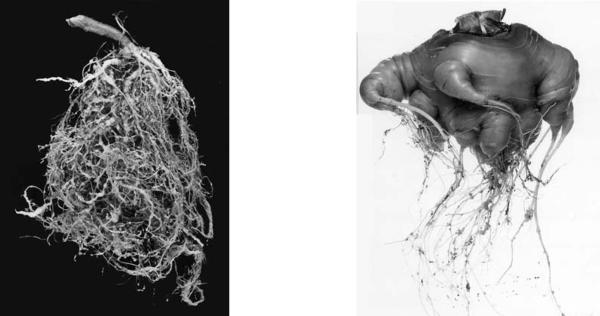
Figure 1. Root-knot damage to vegetables: tomato infected by Meloidogyne arenaria (left) and carrot infected by M. hapla (right).
A list of root-knot-resistant varieties is available from NC State Extension. As a rule, root-knot-resistant varieties are not resistant to all populations of this nematode. Therefore, it is a good idea to examine the crop roots at the end of the season. Look for root galls. If no galls are present, then the resistance is effective.
Because root-knot species differ in their ability to parasitize resistant varieties and rotational crops, identifying nematodes to the species level can help growers choose varieties or rotations suited to the species present. Growers submitting samples to the NCDA&CS Nematode Assay Lab can request root-knot species identification by selecting “Molecular Diagnosis” on the sample submission form.
Cultural practices can also be effective in reducing nematode populations.
- Removing residual crop roots immediately after harvest helps prevent nematode build-up.
- Tilling (hoeing, turning, cultivating) the soil two to four times in the fall allows sun and weather to diminish nematode populations.
- Incorporating organic matter into garden soil depresses nematode populations and increases water-holding capacity of soil and associated beneficial microbes.
- Planting marigolds in a vegetable garden helps control root-knot nematodes.
For more information, see:
- Control of root-knot nematodes in the home vegetable garden
- Southeastern U.S. Vegetable Crop Handbook
- Home and landscape: nematodes
- Root-knot nematodes: biocontrol with marigolds (NCDA&CS Agronomic Division, 2026) TBD
- Managing root-knot nematode species (NCDA&CS Agronomic Division, 2026) TBD
- Root-knot nematodes in the vegetable garden
- Nematode management in the vegetable garden
Nematode Management in Apple
Species and Prevalence
Several species of microscopic nematodes damage apples in North Carolina. These parasites feed on small feeder roots, inhibiting nutrient and water uptake. They also increase susceptibility to root diseases.
Among nematode pests of apple, lesion (Pratylenchus spp.) and dagger (Xiphinema americanum) are the most common, although root-knot, stubby-root, ring, sheath, needle, pin, spiral and stunt are also encountered often in our assay. In the mid-1990s, NCDA&CS conducted a survey of established and recently replanted apple orchards in five western North Carolina counties. Of 51 samples collected, 85% tested positive for lesion and 78% for dagger nematodes; 20% of the samples contained moderate to high numbers of one or both species.
Nematode Damage
Established Orchards. Nematode damage produces no definitive symptoms in established trees. Apple yield and quality tend to be reduced, and trees grow less vigorously. Some leaf chlorosis (yellowing) may occur. The root system is usually restricted, and feeder roots are often absent. Even when most of the trees in an orchard are infected, damage tends to vary from tree to tree.
Replanted Orchards. Nematodes are a component of apple replant disease, which is typified by poor growth and, in some instances, death of young trees. In heavy, poorly drained soils, nematodes are seldom the principal causal factor; however, in light, well-drained soils, they play a greater role. Damaged trees often have unsound root systems and can be easily pushed over.
Taking Nematode Samples
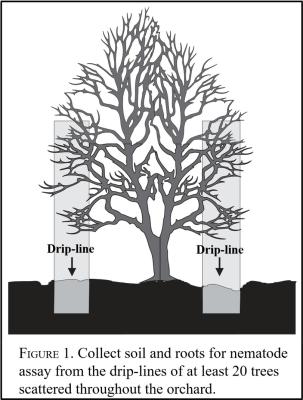
Microscopic analysis (assay) of soil and root samples is the only way to detect nematodes in apple orchards. Dagger nematodes are usually found in root-zone soil, while lesion nematodes are usually found inside the roots. Detailed instructions are available on the NCDA&CS diagnostic sample collection page. Taking a representative nematode sample involves collecting more than a quart of soil and roots from the drip-line of at least 20 trees scattered throughout the orchard (FIGURE 1). Sample material should be collected to a depth of 8–10 inches. Feeder roots must be included. A soil probe is the best tool for collecting soil; a trowel or spade is best for collecting roots. It is important to mix the collected material well before filling the plastic sample bag. The best time to sample is in March or April after the start of new feeder growth.
Nematode Management
Nematode assays are an essential management tool. They are the only way to find out if apple-damaging species are present and, if so, whether these species are present at critical population levels. Without the information assays provide, rational control strategies are impossible.
Established Orchards. In North Carolina, Vydate and Basamid are labeled for use against insects on established apples. These pesticides also have nematicidal effects and can increase orchard yield.
Replanted Orchards or New Plantings. Trees planted in fumigated areas grow faster and yield more than those in nonfumigated plantings. In replanted orchards, preplant fumigation also increases tree survival rates. Orchards treated with a broad-spectrum fumigant yield better than those treated with a nematicide alone, thus indicating that nematodes are not the sole cause of replant problems.
Nematode Testing Sites
Collaborative test-plot research conducted by NCDA&CS, N.C. Cooperative Extension and the NCSU Plant Pathology Department compared efficacy of two postplant and two preplant nematicides. Preplant fumigation produced significant growth response in some apple varieties (Table 1). These findings should encourage use of a fumigant when replanting an orchard—especially if soil-borne diseases are present.
Always follow label instructions when applying pesticides.
Table 1. Preplant fumigation test, 1994.
| Variety | Treatment | Caliper | Height to node (Inches) | Height to terminal (inches |
|---|---|---|---|---|
| Red Fuji/M9/111 | Control | 0.80 | 41.80 | 63.29 |
| Red Fuji/M9/111 | Telone II | 1.25* | 58.20* | 96.20* |
| Empire/EMLA9 | Control | 0.60 | 40.80 | 64.60 |
| Empire/EMLA9 | Telone II | 0.51 | 45.29 | 65.43 |
| Gala/M26 | Control | 0.70 | 43.00 | 65.20 |
| Gala/M26 | Telone II | 0.75 | 44.80 | 78.50* |
| Jonagold/EMLA26 | Control | 0.70 | 43.00 | 65.20 |
| Jonagold/EMLA26 | Telone II | 0.75 | 44.75 | 78.50 |
* Difference from control significant at p = 0.05
Nematode Management in Sweetpotato
The nematode assay for this field detected the presence of a potential hazard for sweetpotato. The detected species can cause yield loss, especially in sandy soils. They may also damage the quality of storage roots.
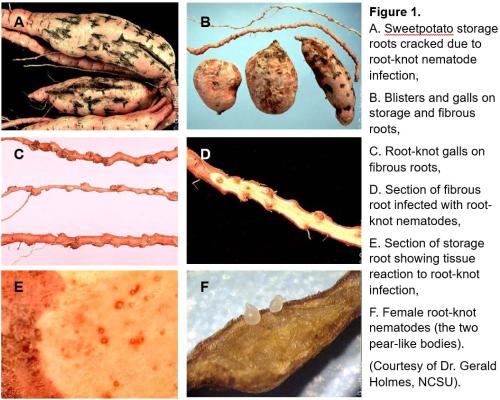
Although several species attack sweetpotato, the southern root-knot nematode (Meloidogyne incognita) and guava root-knot nematode (M. enterolobii) are the most important in North Carolina. On fibrous roots, these pathogens cause the formation of galls. On storage roots, symptoms may include galls, blister-like swelling or, in some instances, cracking (Figure 1).
Root-knot nematodes are controlled by a combination of crop rotation, nematicides, and resistant cultivars. Knowing which species are present is essential, as some cultivars resistant to M. incognita are susceptible to M. enterolobii, and vice versa. A current list of species‑specific cultivar resistance is available from NCSU’s SweetARMOR program. Suitable rotation crops include grasses, peanut, and sorghum. Nematicides currently registered for use in commercial sweetpotato production are listed in NC State Extension’s Sweetpotato Root Knot factsheet. For details on usage of these nematicides, refer to the N.C. Agricultural Chemicals Manual and NCDA&CS pesticide registrations.
Other nematodes that parasitize sweetpotato include reniform (Rotylenchulus reniformis), lesion (Pratylenchus spp.), other root-knot species (M. arenaria, M. hapla and M. javanica), spiral (Helicotylenchus spp.), stunt (Tylenchorhynchus spp.), sting (Belonolaimus longicaudatus), dagger (Xiphinema spp.) and stubby-root (Paratrichodorus minor). Of these, the reniform nematode is reported to cause major losses to sweetpotato (poor root growth and cracking) in Louisiana but, as yet, has not been associated with economic damage to sweetpotato in North Carolina. Still, populations of reniform nematode are increasing here—particularly in counties with high cotton acreage.
There are no sweetpotato cultivars resistant to these other species of nematodes, so management depends on use of crop rotation and nematicides. Good rotation crops include grasses, corn, peanuts, small grain, sorghum, mustard, peppers and soybean (root-knot and reniform resistant). Weed control is also an essential management component because many weeds are excellent host plants for nematodes.
For more information, see: